Question
Explain the application of $p-n$ junction diode as a full-wave rectifier.
Answer

Image

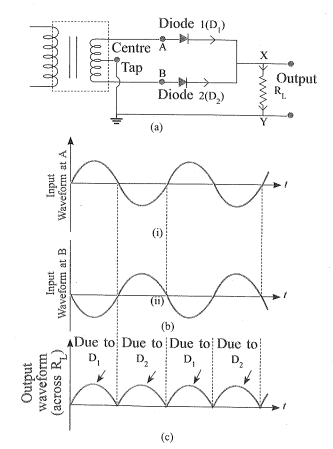
The circuit diagram of the full-wave rectifier is shown in the figure. In full wave rectifier, two $p-n$ junction diodes are used.
In this type of rectifier, the rectified output voltage is obtained during both the positive as well as negative half of ac cycle. Hence, it is known as full-wave rectifier.
As shown in fig., the $p$-side of the two diodes are connected to the ends of the secondary of the transformer. The $n$-side of the diodes are connected together and the output is taken between this common point of diodes and the mid-point of the secondary of the transformer. So for a full wave rectifier the secondary of the transformer is provided with a centre tapping and so it is called centre-tap transformer.
As can be seen from fig. (c), the voltage rectified by each diode is only half the total secondary voltage. Each diode rectifies only for half the cycle, but the two do so for alternate cycles. Thus the output between their common terminals and the centre tap of the transformer becomes a full-wave rectifier output.
Suppose the input voltage to A with respect to centre tap at any instant is positive. At that instant, voltage B being out of phase should be negative. In this case, diode $D _1$ gets forward biased and conducts, while $D _2$ gets reverse biased and does not conduct. Hence, as shown in fig. c, output current is obtained between two terminals of $R _{ L }$ during this half-cycle.
During the other half-cycle, voltage at A is negative and voltage at B is positive. In this case diode $D_1$ is in reverse bias condition and $D_2$ is in forward bias. Hence, in this part of cycle, $D _2$ conducts and output voltage is obtained.
Thus, we get output voltage during both positive as well as negative half of the cycle.

Need a full question paper?

Generate a complete, print-ready paper with questions like this in minutes — across 16+ boards, with answer keys.

Start Generating Free

Similar questions

Define half-life of a radioactive sample. Which of the following radiations: $\alpha-$rays, $\beta-$rays and $\gamma-$rays.
  1. Are similar to X-rays.
  2. Are easily absorbed by matter.
  3. Travel with the greatest speed.
  4. Are similar in nature to cathode rays?
Indium antimonide has a band gap of 0.23eV between the valence and the conduction band. Find the temperature at which kT equals the band gap.
Define electric current and current density. By giving an example prove that electric current is a scalar quantity but not a vector quantity. Explain electric current in any conductor.
A current-carrying circular coil of 100 turns and radius 5.0cm produces a magnetic field of 6.0 × 10⁻⁵T at its centre. Find the value of the current.
Is there any meaning of "Weight of the earth"?
A flint glass prism and a crown glass prism are to be combined in such a way that the deviation of the mean ray is zero. The refractive index of flint and crown glasses for the mean ray are 1.620 and 1.518 respectively. If the refracting angle of the flint prism is 6.0°, what would be the refracting angle of the crown prism?
The drift current in a reverse-biased p-n junction increases in magnitude if the temperatu,re of the junction is increased. Explain this on the basis of creation of hole-electron pairs.
(a) What happens if a bar magnet is cut into two pieces: (i) transverse to its length, (ii) along its length?
(b) A magnetised needle in a uniform magnetic field experiences a torque but no net force. An iron nail near a bar magnet, however, experiences a force of attraction in addition to a torque. Why?
(c) Must every magnetic configuration have a north pole and a south pole? What about the field due to a toroid?
(d) Two identical looking iron bars A and B are given, one of which is definitely known to be magnetised. (We do not know which one.) How would one ascertain whether or not both are magnetised? If only one is magnetised, how does one ascertain which one? [Use nothing else but the bars A and B.]
Two bodies make an elastic head-on collision on a smooth horizontal table kept in a car. Do you expect a change in the result if the car is accelerated on a horizontal road because of the noninertial character of the frame? Does the equation "Velocity of separation = Velocity of approach" remain valid in an accelerating car? Does the equation "Final momentum = Initial momentum" remain valid in the accelerating car?
  1. In a typical nuclear reaction, e.g.  

$^{2}_{1}\text{H} +^{2}_{1}\text{H}\rightarrow^{3}_{2}\text{He} + \text{n} + 3.27\text{MeV}$ 

although number of nucleons is conserved, yet energy is released. How? Explain.

  1. Show that nuclear density in a given nucleus is independent of mass number A.