Question
Explain the basic construction of a galvanometer.
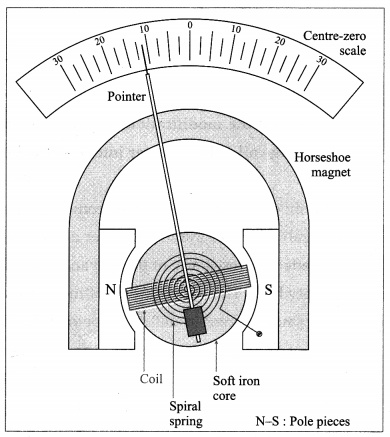
Answer

A galvanometer consists of a coil of a large number of turns of fine insulated copper wire wound on a rectangular nonconducting, nonmagnetic frame. The coil is pivoted (or suspended) between cylindrically concave pole pieces of a horseshoe strong permanent magnet. The coil swings freely around a cylindrical soft iron core fitted between the pole pieces. The deflection of the coil can be read with a pointer attached to it. The position of the pointer on the scale provided depends on the current passing through the galvanometer (or the potential difference across it). A galvanometer can be used as an ammeter or a voltmeter with a suitable modification.Image[Note : A table galvanometer has a resistance of about 50 Ω and can carry a current up to about 1 mA.]

Need a full question paper?

Generate a complete, print-ready paper with questions like this in minutes — across 16+ boards, with answer keys.

Start Generating Free

Similar questions

An electron in an atom is revolving round the nucleus in a circular orbit of radius $5.3 \times 10^{-11} m$, with a speed of $2 \times$ $10^6 ms^{-1}$ Find the resultant orbital magnetic moment and angular momentum of electron. (charge on electron $e =$ $1.6 \times 10^{-19} C$, mass of electron $m _{ e }=9.1 \times 10^{-31} kg$.)
Derive an expression for the net rate of loss of heat per unit area by a perfect blackbody in a cooler surroundings.
Determine the angle to be made with the vertical by a two-wheeler while turning on a horizontal track?
Find the temperature of a blackbody if its spectrum has a peak at (a) $\lambda_{\max }=700 nm$ (visible), (b) $\lambda_{\max }=3 cm$ (microwave region) and (c) $\lambda_{\max }=3 m$ (short radio waves) (Take Wien's constant $b =2.897 \times 10^{-3} m K$ ).
Describe the construction of a suspended-type moving-coil galvanometer with a neat labelled diagram.
Assuming the expression for the kinetic energy of a body rolling on a plane surface without slipping, deduce the expression for the total kinetic energy of rolling motion for
(i) a ring
(ii) a disk
(iii) a hollow sphere. Also, find the ratio of rotational kinetic energy to total kinetic energy for each body.
It is observed in an experiment on photoelectric effect that an increase in the intensity of the incident radiation does not change the maximum kinetic energy of the electrons. Where does the extra energy of the incident radiation go? Is it lost? State your answer with explanatory reasoning.
Write a short note on Indian musical scale.
What is meant by harmonics? Show that only odd harmonics are present as overtones in the case of an air column vibrating in a pipe closed at one end.
Obtain the condition for not toppling (rollover) for a four-wheeler. On what factors does it depend and how?