Question
Explain the Bohr model for the hydrogen atom.

Answer

SELF

Need a full question paper?

Generate a complete, print-ready paper with questions like this in minutes — across 16+ boards, with answer keys.
Start Generating Free

Similar questions

8 Arrange benzene, n-hexane and ethyne in decreasing order of acidic behaviour. Also give reason for this behaviour.
Calcium carbonate reacts with aqueous HCl to give $\mathrm{CaCl}_2$ and $\mathrm{CO}_2$ according to the reaction, $\mathrm{CaCO}_{3(\mathrm{~s})}+2 \mathrm{HCl}_{(\mathrm{aq})} \rightarrow$ $\mathrm{CaCl}_{2(\mathrm{aq})}+\mathrm{CO}_{2(g)}+\mathrm{H}_2 \mathrm{O}_{(l)}$
What mass of $\mathrm{CaCO}_3$ is required to react completely with 25 mL of 0.75 M HCl ?
Discuss the principle and method of softening of hard water by synthetic ionexchange resins.
  1. $1.84\ g$ of mixture of $CaCO_3$ and $MgCO_3\rightarrow$​​​​​​​ is strongly heated till no further loss of mass takes place. The residue weighs 0.96g. Calculate the percentage composition of the mixture.
  2. What will be the molality of the solution containing $18.25\ g$ of HCl gas in $500\ g$ of water?
The reactant which is entirely consumed in reaction is known as limiting reagent. In the reaction 2A + 4B → 3C + 4D, when 5 moles of A react with 6 moles of B, then
  1. Which is the limiting reagent?
  2. Calculate the amount of C formed?
A welding fuel gas contains carbon and hydrogen only. Burning a small sample of it in oxygen gives 3.38g carbon dioxide, 0.690 g of water and no other products. A volume of 10.0L (measured at STP) of this welding gas is found to weigh 11.6g. Calculate.
  1. Empirical formula.
  2. Molar mass of the gas.
  3. Molecular formula.
A student forgot to add the reaction mixture to the round bottomed flask at $27^\circ\ C$ but instead he/she placed the flask on the flame. After a lapse of time, he realized his mistake, and using a pyrometer he found the temperature of the flask was $477^\circ\ C$. What fraction of air would have been expelled out?
If the starting material for the manufacture of silicones is $RSiCl_3$, write the structure of the product formed.
  1. Classify following oxides as natural, acidic, basic or amphoteric:
$CO, B_2O_3, SiO_2, CO_2, Al_2O_3, PbO_2, Tl_2O_3$
  1. Write suitable chemical equations to show their nature.
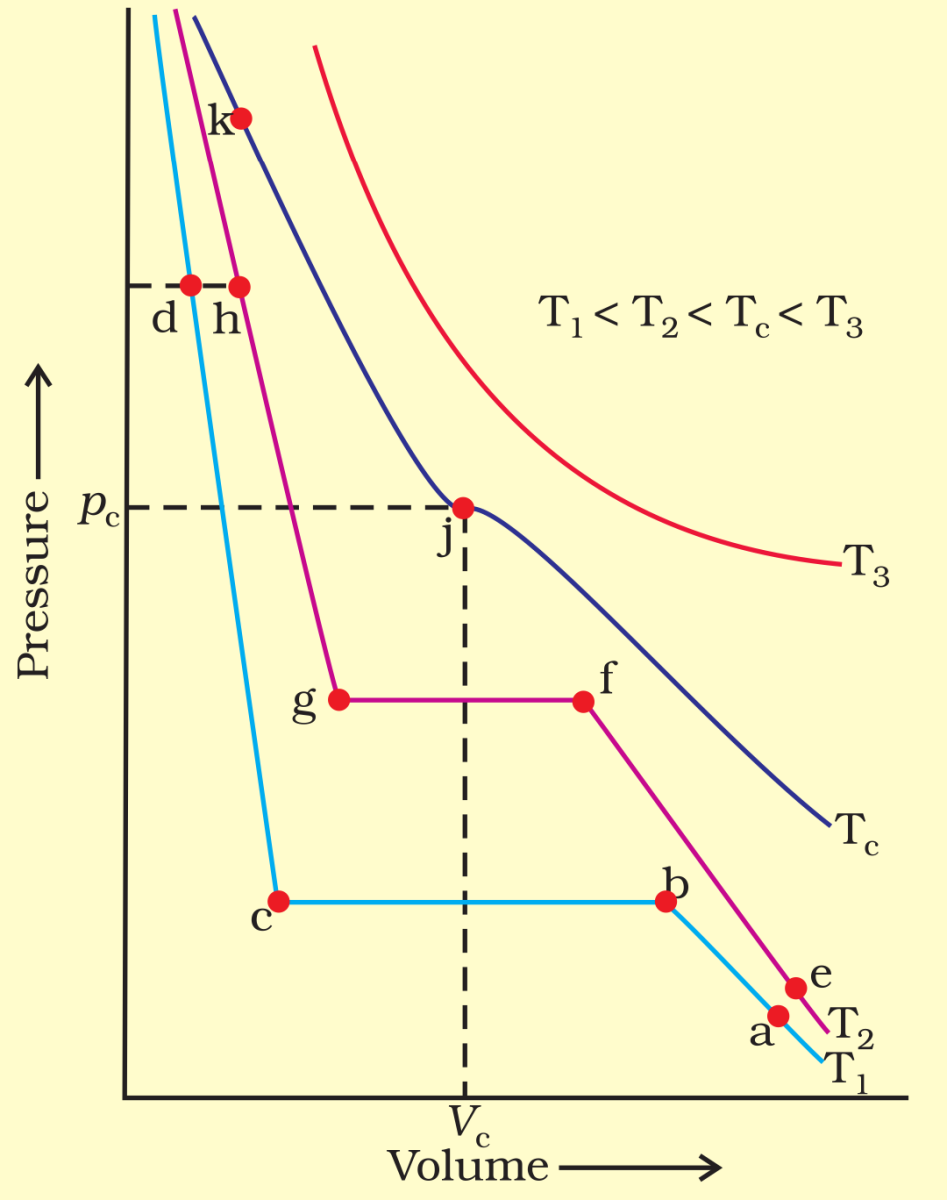
Isotherms of carbon dioxide gas are shown in Fig. Mark a path for changing gas into liquid such that only one phase (i.e., either a gas or a liquid) exists at any time during the change. Explain how the temperature, volume and pressure should be changed to carry out the change.