Question
Explain the bonding in coordination compounds in terms of Werner’s postulates.

Answer

The main postulates of Werner's theory of coordination compounds are as follows:
  1. Metals possess two types of valencies called
  1. Primary valency which are ionisable;
  2. secondary valency which are non- ionisable
  1. Primary valency is satisfied by the negative ions and it is that which a metal exhibits in the formation of its simple salts.
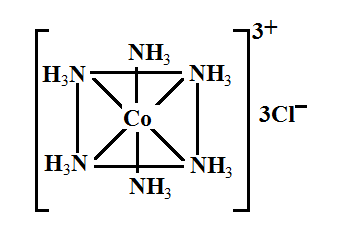
  2. Secondary valencies are satisfied by neutral ligand or negative ligand and are those which metal exercises in the formation of its complex ions. Every cation has a fixed number of secondary valencies which are directed in space about central metal ion in certain fixed directions, e.g,, In $\ce{CoCl3-6NH3},$ valencies between $Co$ and $Cl$ are primary valencies and valencies between $Co$ and $\ce{NH3}$ are secondary. In $\ce{COCl3-6NH3},$ six ammonia molecules linked to $Co$ by secondary valencies are directed to six corners of a regular octahedron and thus account for structure of $\ce{COCl3-6NH3}$ as follows:
In modern theory, it is now referred as coordination number of central metal atom or ion.

Need a full question paper?

Generate a complete, print-ready paper with questions like this in minutes — across 16+ boards, with answer keys.
Start Generating Free

Similar questions

a. Give the chemical reaction involved when $p-$ nitrotoluene undergoes Etard reaction.
b. Why does Benzoic acid exist as a dimer in an aprotic solvent?
c. Benzene on reaction with methylchloride in the presence of anhydrous $\ce{AlCl3}$ forms toluene. What is the expected outcome if benzene is replaced by benzoic acid? Give a reason for your answer.
On the basis of which evidences $D\ -$ glucose was assigned the following structure?
$\text{CHO}\\ \ \ |\\ (\text{CH}\text{OH})_{4}\\\ \ |\\\text{CH}_{2}\text{OH}$
Write the name, stereochemistry and magnetic behaviour of the following:
$($At. nos. $\ce{Mn = 25, Co = 27, Ni = 28)}$
  1. $\ce{K_4[Mn(CN)_6]}.$
  2. $\ce{[Co(NH_3)_5Cl]Cl_{2.}}$
  3. $\ce{K_2[Ni(CN)_4]}.$
​​​​​​​
Write the mechanism of acid dehydration of ethanol to yield ethane.
Write the names and structures of the monomers of the following polymers?
(i) Buna-S
(ii) Buna-N
(iii) Dacron
(iv) Neoprene
A 4% solution (w/w) of sucrose (M = 342 g $ mol^{-1} $) in water has a freezing point of 271.15 K. Calculate the freezing point of 5% glucose (M = 180 g $ mol^{-1} $) in water. (Given: Freezing point of pure water = 273.15 K)
Calculate the boiling point of solution when $4 g$ of $\ce{MgSO4}\ (M = 120 g\ mol^{-1})$ was dissolved in $100 g$ of water, assuming $\ce{MgSO4}$ undergoes complete ionization.
$(K_b$ for water $=0.52 K \ kg \ mol^{-1}).$
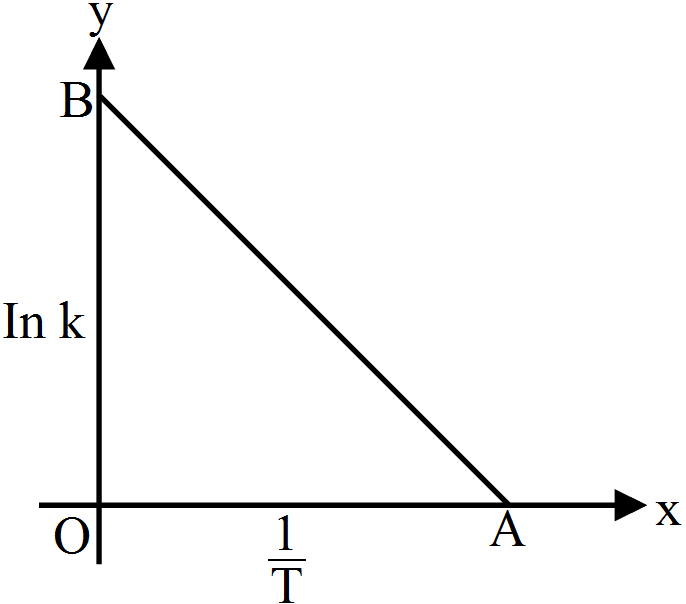
A graph between ln $k$ and $\frac{1}{\text{t}}$ for a reaction is given. Here $k$ is rate constant and $T$ is temperature in Kelvin.If $OA = a$ and $OB = b,$ answer the following:
  1. What is the activation energy $(Ea)$ of the reaction?
  2. What is the frequency factor $(A)$ for the reaction?
A solution containing $30\ g$ of non-volatile solute exactly in $90\ g$ of water has a vapour pressure of $2.8\ kPa$ at $298\ K.$ Further, $18\ g$ of water is then added to the solution and the new vapour pressure becomes $2.9\ kPa$ at $298\ K.$ Calculate:
  1. Molar mass of the solute.
  2. Vapour pressure of water at $298\ K.$
A $4\%$ solution$(w/ w)$ of sucrose $(M = 342g\ mol^{-1})$ in water has a freezing point of $271.15K.$ Calculate the freezing point of $5\%$ glucose $(M = 180g\ mol^{-1})$ in water.
$($Given: Freezing point of pure water $= 273.15K)$