Question
Explain the bonding in coordination compounds in terms of Werner’s postulates.
Answer

The main postulates of Werner's theory of coordination compounds are as follows:
  1. Metals possess two types of valencies called​​​​​​​
  1. Primary valency which are ionisable;
  2. secondary valency which are non- ionisable
  1. Primary valency is satisfied by the negative ions and it is that which a metal exhibits in the formation of its simple salts.
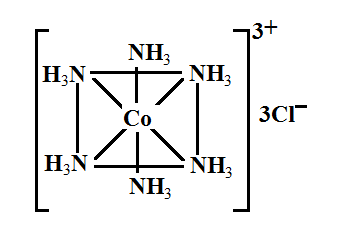
  2. Secondary valencies are satisfied by neutral ligand or negative ligand and are those which metal exercises in the formation of its complex ions. Every cation has a fixed number of secondary valencies which are directed in space about central metal ion in certain fixed directions, e.g,, In CoCl3-6NH3, valencies between Co and Cl are primary valencies and valencies between Co and NH3 are secondary. In COCl3-6NH3, six ammonia molecules linked to Co by secondary valencies are directed to six corners of a regular octahedron and thus account for structure of COCl3-6NH3 as follows:

In modern theory, it is now referred as coordination number of central metal atom or ion.

Need a full question paper?

Generate a complete, print-ready paper with questions like this in minutes — across 16+ boards, with answer keys.
Start Generating Free

Similar questions

Lanthanum, gadolinium and lutetium are extraordinarily stable in +3 oxidation state. Explain.
(Atomic number: La = 57, Gd = 64, Lu = 71)
Explain how does -OH group attached to a carbon of benzene ring activate towards electrophilic substitution?
Although +3 oxidation states is the characteristic oxidation state of lanthanoids but cerium shows +4 oxidation state also. Why?
(a) Account for the following :
(i) Copper (I) compounds are white whereas Copper (II) compounds are coloured.
(ii) Chromates change their colour when kept in an acidic solution.
(iii) $Zn , Cd , Hg$ are considered as $d$-block elements but not as transition elements.
(b) Calculate the spin only moment of $Co ^{2+}( Z =27)$ by writing the electronic configuration of Co and $Co ^{2+}$.
Nalorphene $\left( C _{19} H _{21} NO _3\right)$, similar to morphine, is used to combat withdrawal symptoms in narcotic users. Dose of nalorphene generally given is 1.5 mg. Calculate the mass of $1.5 \times 10^{-3} m$ aqueous solution required for the above dose.
a. Give the chemical reaction involved when p-nitrotoluene undergoes Etard reaction.
b. Why does Benzoic acid exist as a dimer in an aprotic solvent?
c. Benzene on reaction with methylchloride in the presence of anhydrous AlCl3 forms toluene. What is the expected outcome if benzene is replaced by benzoic acid? Give a reason for your answer.
Explain Crystal field splitting in tetrahedral complax.
Define the following as related to protein :
Primary structure
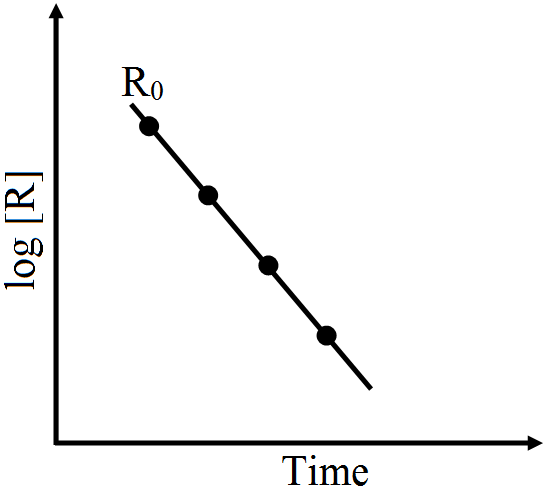
Observe the graph in diagram and answer the following questions.

  1. If slope is equal to -2.0 × 10⁻⁶ sec-1 , what will be the value of rate constant?
  2. How does the half-life of zero order reaction relate to its rate constant?
What is spectrochemical series? Explain the difference between a weak field ligand and a strong field ligand.