Question
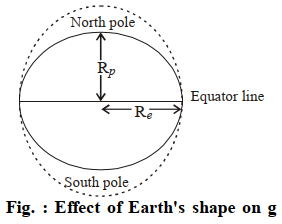
Explain the change in the value of $g$ due to shape of the Earth.

Need a full question paper?

Generate a complete, print-ready paper with questions like this in minutes — across 16+ boards, with answer keys.
Start Generating Free

Similar questions

Which of the following functions of time represent (a) simple harmonic, (b) periodic but not simple harmonic, and (c) non-periodic motion? Give period for each case of periodic motion ($\omega$ is any positive constant):$\sin^3\omega\text{t}$
What are the limitations of the first law of thermodynamics?
Suppose the platform of the previous problem is brought to rest with the ball in the hand of the kid standing on the rim. The kid throws the ball horizontally to his friend in a direction tangential to the rim with a speed v as seen by his friend. Find the angular velocity with which the platform will start rotating.
A thin spherical shell of radius R lying on a rough horizontal surface is hit sharply and horizontally by a cue. Where should it be hit so that the shell does not slip on the surface?
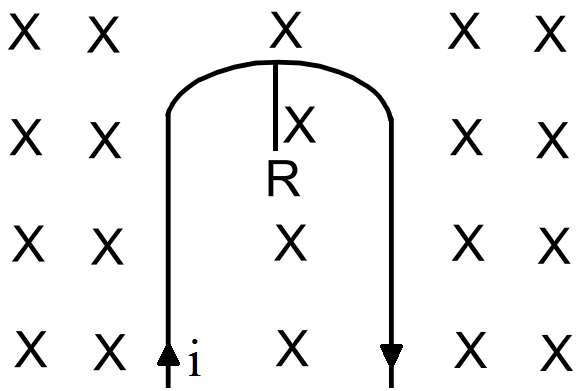
A rigid wire consists of a semi-circular portion of radius R and two straight sections The wire is partially immersed in a perpendicular magnetic field B, as shown in the figure. Find the magnetic force on the wire if it carries a current i.
Explain why A fluid flowing out of a small hole in a vessel results in a backward thrust on the vessel.
Define Escape velocity and find its value.
In macroscopic level of Physics, gravitational force is dominant as compared to electromagnetic force, why?
The $\text{K}_\beta$ X-ray of argon has a wavelength of 0.36nm. The minimum energy needed to ionize an argon atom is 16eV. Find the energy needed to knock out an electron from the K shell of an argon atom.
If two waves of the same frequency but of different amplitudes travelling in opposite directions through a medium superpose upon each other, will they form stationary wave? Is energy transferred? Are there any nodes?