Chemistry in Everyday Life — Chemistry STD 12 Science — Question
Gujarat BoardEnglish MediumSTD 12 ScienceChemistryChemistry in Everyday Life2 Marks
Question
Explain the cleaning action of soaps.
✓
Answer
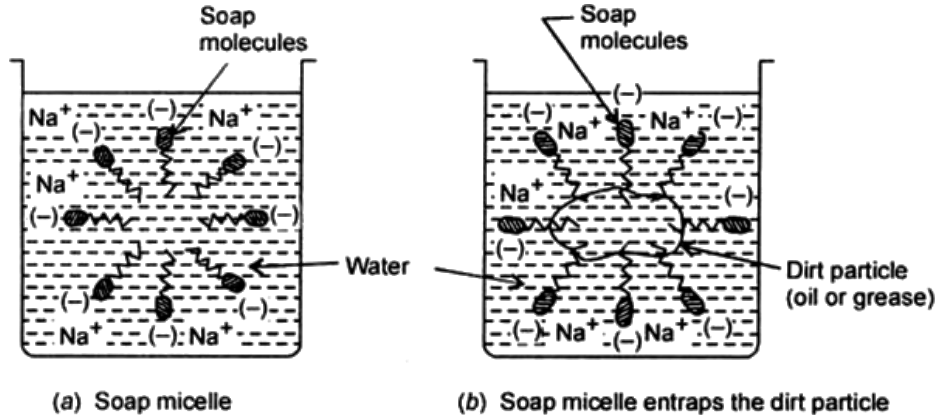
A soap molecule is made up of two parts: one part is a long hydrocarbon chain which is non-ionic, and the other part is a short ionic group called carboxylate group $(–COO–Na^+).$ The non-ionic, hydrocarbon part of soap molecule is water repelling (hydrophobic) but it dissolves dirt and grease particles. So, the dirt and grease present on a piece of dirty cloth attach themselves to the hydrocarbon part of the soap molecule. The ionic part of soap molecule, however, attaches to the polar water molecules and thus pulls the dirt and grease particles away from the surface of dirty cloth thereby making the cloth clean. Fig. Cleansing action of soap.
When soap is dissolved in water, it forms a micelle [Fig.(a)]. In a micelle, the soap molecules are arranged radially, with the hydrocarbon and directed towards the centre and the water attracting carboxylate part directed outwards [Fig.(b)]. The dirt and grease particles lying on the surface of clothe wetted by soap are thus entrapped by these micelles and removed.
Need a full question paper?
Generate a complete, print-ready paper with questions like this in minutes — across 16+ boards, with answer keys.