Maharashtra BoardEnglish MediumSTD 9ScienceAcids, Bases and Salts5 Marks
Question
Explain the conduction of electricity through solutions of ionic compounds
✓
Answer
Electrons conduct electricity through electrical wires, and ions conduct electricity through a liquid or a solution.
Electrons leave the battery at the negative terminal, complete the electric circuit and enter the battery at the positive terminal.
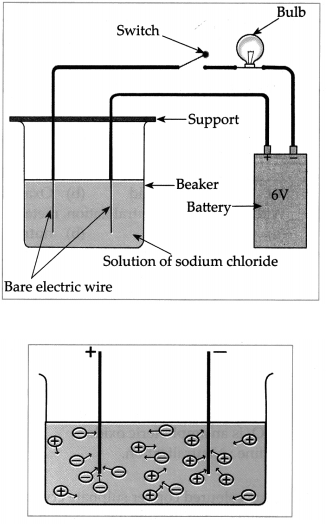
When there is a liquid or a solution in the circuit, two rods, wires or plates are immersed in it. These are called electrodes.
Electrodes are made of conducting solid. The electrode connected to negative terminal of a battery by means of a conducting wire is called a cathode and the electrode connected to the positive terminal of a battery is called anode.
We have seen that salts, strong acids and strong bases dissociates almost completely in their aqueous solutions.
Therefore the aqueous solutions of all these three contain large number of cations and anions.
A characteristic of liquid state is the mobility of its particles. Due to its mobility the positive charged ions of the solution are attracted to the negative electrode or cathode.
On the other hand, the negative charged ions of the solution are attracted to the positive electrode or anode.
The movement of ions in the solution towards the respective electrodes accounts to the conduction of electricity through the solution.
From this we can understand that those liquids or solutions which contain a large number of dissociated ions conduct electricity.
Need a full question paper?
Generate a complete, print-ready paper with questions like this in minutes — across 16+ boards, with answer keys.