Question
Explain the construction and working of the Moving coil Galvanometer.

Answer

Construction:
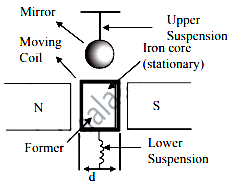
i. M.C.G. consists of a coil of several turns mounted (suspended or pivoted) in such a way that it can freely rotate about a fixed axis, in a radial uniform magnetic field.
ii. A soft iron cylindrical core makes the field radial and strong.

Moving coil galvanometer
Working:
i. The coil rotates due to a torque acting on it as the current flows through it. The torque acting on the current-carrying coil is $\tau=$ NIAB $\sin \theta$.
Here $\theta=90^{\circ}$ as the field is radial.
$\therefore \tau= NIAB$
where $A$ is the area of the coil, $B$ the strength of the magnetic field, $N$ the number of turns of the coil, and I the current in the coil.
ii. This torque is counter balanced by a torque due to a spring fitted at the bottom so that a fixed steady current I in the coil produces a steady angular deflection $\Phi$.
iii. The larger the current is, the larger is the deflection and the larger is the torque due to the spring. If the deflection is $\Phi$, the restoring torque due to the spring is equal to $K \Phi$ where $K$ is the torsional constant of the spring. Thus, $K \Phi=N I A B$, and the deflection $\Phi=$ $\left(\frac{ NAB }{ K }\right) I$
This means the deflection $\Phi$ is proportional to the current I i.e., $\Phi \propto I$.

Need a full question paper?

Generate a complete, print-ready paper with questions like this in minutes — across 16+ boards, with answer keys.
Start Generating Free

Similar questions

Determine the electric potential at the midpoint of the line joining two charges $2 \times 10^{-6} C$ and $-1 \times 10^{-6} C$ placed in vacuum $10 \ cm$ apart.
An alpha particle (the nucleus of helium atom) (with charge $+2e$) is accelerated and moves in a vacuum tube with kinetic energy $= 10.00\ MeV.$ On applying a transverse a uniform magnetic field of $1.851\ T,$ it follows a circular trajectory of radius $24.60\ cm.$ Obtain the mass of the alpha particle. [charge of electron $= 1.62 \times 10^{-19} C$]
In Young's experiment the ratio of intensity at the maxima and minima in the interference pattern is \(36: 16\). What is the ratio of the widths of the two slits?
Prove theoretically, the relation between e.m.f. induced and rate of change of magnetic flux in a coil moving in a uniform magnetic field.
An unknown resistance is placed in the left gap and resistance of $50$ ohms is placed in the right gap of a meter bridge. The null point is obtained at $40\ cm$ from the left end. Determine the unknown resistance.
Show that the average energy of the molecules of a gas is directly proportional to the absolute temperature of the gas.
The kinetic energy of $1 \mathrm{~kg}$ of oxygen at $300 \mathrm{~K}$ is $1.169 \times 10^5 \mathrm{~J}$. Find the kinetic energy of $4 \mathrm{~kg}$ of oxygen at $400 \mathrm{~K}$.
A particle in linear SHM is in its 5th oscillation. If its displacement at that instant is $-\frac{1}{2} A$ and is moving toward the mean position, determine its phase at that instant.
Identify some examples of streamline flow and turbulent flow in everyday life. How would you explain them ? When would you prefer a streamline flow?
Explain with neat circuit diagram how will you determine unknown resistance by using meterbridge experiment.