Question
Explain the cyclic structure of glucose.

Answer

self

Need a full question paper?

Generate a complete, print-ready paper with questions like this in minutes — across 16+ boards, with answer keys.
Start Generating Free

Similar questions

Explain the method of preparing haloalkanes by free radical substitution of alkanes.
The time required for $10\%$ completion of a first order reaction at $298K$ is equal to that required for its $25\%$ completion at $308K.$ If the value of $ A$ is $4 \times 10^{10}s^{–1}.$ Calculate $k$ at $318K$ and $E_a.$
  1. With reference to structural variability and chemical reactivity, write the differences between lanthanoids and actinoids.
  2. Name a member of the lanthanoid series which is well known to exhibit $+4$ oxidation state.
  3. Complete the following equation:
$\text{MnO}_{4}^{-}+\text{8H}^{+}+\text{5e}^{-}\rightarrow$
  1. Out of $Mn^{3+}$ and $Cr^{3+}$, which is more paramagnetic and why?
$($Atomic nos: $Mn = 25, Cr = 24).$
With the help of an example explain what is meant by pseudo first order reaction.
Explain oxidation and reduction reactions of carbonyl compounds.
  1. Name the element of $3d$ transition series which shows maximum number of oxidation states. Why does it show so?
  2. which transition metal of $3d$ series has positive $E^o(M^{2+}/M)$ value and why?
  3. Out of $Cr^{3+}$ and $Mn^{3+}$, which is a stronger oxidizing agent and why?
  4. Name a member of the lanthanoid series which is well known to exhibit $+2$ oxidation state.
  5. Complete the following equation:
$MnO^-_4+8H^++5e^-\rightarrow $
Write a detailed note on enzymes.
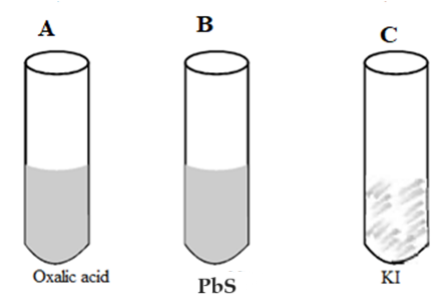
$(a).$ A purple colour compound $A,$ which is a strong oxidising agent and used for bleaching of wool, cotton, silk and other textile fibres was added to each of the three test tubes along with $H_2SO_4.$ It was followed by strong heating.
Image
In which of the above test tubes; $A, B$ or $C:$
$(i)$ Violet vapours will be formed
$(ii)$ The bubbles of gas evolved will extinguish a burning matchstick. Write an equation for each of the above observations.
$b. A$ metal ion $M^{n+}$ of the first transition series having $d^5$ configuration combines with three didentate ligands. Assuming $\Delta_0 < P:$
$(i)$ Draw the crystal field energy level diagram for the $3d$ orbital of this complex.
$(ii)$ What is the hybridisation of Mnt in this complex and why?
$(iii)$ Name the type of isomerism exhibited by this complex.
  1. What may be the possible oxidation states of the transition metals with the following d electronic configurations in the ground state of their atoms:
  1. $3d^34s^2, 3d^54s^2$ and $3d^6 4s^3$. Indicate relative stability of oxidation states in each case.
  2. Write steps involved in the preparation of $(i) Na_2CrO_4$ from chromite ore and $(ii) K_2MnO_4$ from pyrolusite ore.
At $291K$, the molar conductivities at infinite dilution of $NH_4Cl, NaOH$ and $NaCl$ are $129.8, 217.4$ and $108.9S \ cm^2 mol^{-1}$ respectively. If the molar conductivity of a centinormal solution of $NH_4OH$ is $9.33S \ cm^2 mol^{-1},$ what is the percentage dissociation of $NH_4OH$ at this dilution? Also calculate the dissociation constant of $NH_4OH.$