Question
Explain the de-Broglie wavelength by explaining the waveform of matter.

Answer

Some phenomena associated with light like diffraction, interference and polarisation show that light (radiation) has a wave-form.
Similarly, the photoelectric effect, the Compton effect, show that light has a particle-form.
Thus, radiation has dual nature.
The first scientist named Louis de-Broglie questioned whether the universe had symmetry, so if radiation (energy) could act as a particle, then a particle could also act as radiation. If radiation can have dual nature then particle can also have dual nature.
de-Broglie stated that when a particle (such as an electron, proton etc) moves, it moves in a wave-form.
de-Broglie said that if a particle has mass $m$ and is moving with speed $v$, then the wave length of the wave of the particle can be given by the formula
$\lambda=\frac{h}{p}=\frac{h}{m v}$
This wave length is called the de-Broglie wave length of the particle. The above equation is known as the de-Broglie relation.
The wave length of a photon of radiation, $\lambda=\frac{c}{\nu} \quad(\because c=v \lambda)$
$\lambda=\frac{h}{p} \quad$ (momentum $p=\frac{h v}{c} \therefore \frac{c}{v}=\frac{h}{p}$ )
Thus, the de-Broglie wave length and the wave length of a photon of radiation can be given by the same formula.
The de-Broglie wave length $\lambda=\frac{h}{p}$.
In this equation, the physical quantity on the left is wave form and the momentum ( $p$ ) on the right side is the physical quantity of the particle form. Thus this equation relates the wave nature and the particle nature.
Davisson and Germer's experiment proved deBroglie's hypothesis experimentally.

Need a full question paper?

Generate a complete, print-ready paper with questions like this in minutes — across 16+ boards, with answer keys.

Start Generating Free

Similar questions

In the original Fizeau method, the light travelled 8.6km and then returned. What could be the difficulty if this distance is taken as 8.6m?
Write some properties of electromagnetic waves.
Obtain the first Bohr’s radius and the ground state energy of a muonic hydrogen atom [i.e., an atom in which a negatively charged muon $(\mu)$ of mass about 207me orbits around a proton].
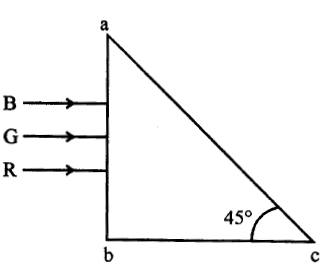
Three light rays red (R), green (G) and blue (B) are incident on a right-angled prism ‘abc’ at face ‘ab’. The refractive indices of the material of the prism for red, green and blue wavelengths are 1.39, 1.44 and 1.47 respectively. Out of the three which colour ray will emerge out of face ‘ac’? Justify your answer. Trace the path of these rays after passing through face ‘ab’.

A 12.9 eV beam of electrons is used to bombard gaseous hydrogen at room temperature. Upto which energy level the hydrogen atoms would be excited?
Calculate the wavelength of the first member of Paschen series and first member of Balmer series.
A metre stick is held vertically with one end on a rough horizontal floor. It is gently allowed to fall on the floor. Assuming that the end at the floor does not slip, find the angular speed of the rod when it hits the floor.
Using Bohr’s postulates, obtain the expression for the total energy of the electron in the stationary states of the hydrogen atom. Hence draw the energy level diagram showing how the line spectra corresponding to Balmer series occur due to transition between energy levels.
There are energy bands in a solid. Do we have really continuous energy variation in a band or do we have very closely spaced but still discrete energy levels?
A block of mass 0.5kg hanging from a vertical spring executes simple harmonic motion of amplitude 0.1m and time period 0.314s. Find the maximum force exerted by. the spring on the block.
A square loop of side $10 cm$ and resistance $0.5 \Omega$ is placed vertically in the east-west plane. A uniform magnetic field of $0.10 T$ is set up across the plane in the north-east direction. The magnetic field is decreased to zero in $0.70 s$ at a steady rate. Determine the magnitudes of induced emf and current during this time-interval.