Question
Explain the difference between behaviour of a conductor and a dielectric inside external electric field.

Answer

Image

Image
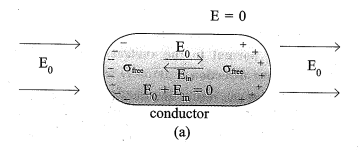
Conductor in external electric field :
As shown in figure (a) when a conductor is placed in external electric field, static electric charge is induced on its surface. Electric field is created inside the conductor due to this electric charge.
The electric field generated due to induced charges, opposes the external electric field in the region inside the conductor.
In stable situation, both these electric fields cancel out their mutual effect. When both these electric fields are of equal magnitude the net electric field inside conductor vanishes to zero.
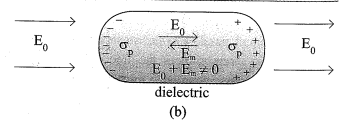
Dielectric in the external electric field :
Non-conducting material is called dielectric. Free motion of electric charges is not possible in dielectric.
The external electric field induces dipole moment either by pulling the molecules of dielectric or by their re-arrangement. Due to which some net charge is induced on the surface of the dielectric.
The electric field produced by this electric charge opposes the external electric field.
Due to which electric field inside the dielectric decreases.
In non-conducting materials, magnitudes of both these electric fields cannot be equal and hence net electric field inside die-electric is not zero.

Need a full question paper?

Generate a complete, print-ready paper with questions like this in minutes — across 16+ boards, with answer keys.

Start Generating Free

Similar questions

Two point electric charges of unknown magnitude and sign are placed at some distance ‘d’ apart. The electric field intensity is zero at a point, not between the charges but on the line joining them.
Write two essential conditions for this to happen.
The output of an OR gate is connected to both the inputs of a NAND gate. Draw the logic circuit of this combination of getes and write its truth table.
Prove that $\vec{\text{A}}.(\vec{\text{A}}\times\vec{\text{B}})=0.$
Two bulbs are rated $(P_1, V)$ and $(P_2, V)$. If they are connected in series in parallel across a supply V.
Find the power dissipated in the two combinations in terms of $P_1$ and $P_2$.
Obtain expression of self inductance of a solenoid having length $l$ and cross-section of area A .
Give the sign convection for electric or magnetic field leaving and entering the plane of the paper.
Two metallic wires P and Q of the same material and same length but different cross-sectional areas A1 and A2 are joined together and then connected to a source of emf. Find the ratio of the drift velocities of free electrons in the wires P and Q, if the wires are connected (i) in series, and (ii) in parallel.
Net capacitance of three identical capacitors in series is $1\mu\text{F}.$ What will be their net capacitance if connected in parallel?
Find the ratio of energy stored in the two configurations if they are both connected to the same source.
Find the intensity at a point on a screen in Young’s double slit experiment where the interfering waves have a path difference of (i) $\lambda/6$, and (ii) $\lambda/2.$
Define refractive index of a transparent medium.
A ray of light passes through a triangular prism. Plot a graph showing the variation of the angle of deviation with the angle of incidence.