Question
Explain the difference between electric potential and electrical potential energy and explain the relationship between them.

Answer

Electric potential is the work done in bringing a unit positive charge from infinity without acceleration, whereas electrical potential energy is the work done in bringing the given charges from infinity to their position
Electric potential,
$V =\frac{1}{4 \pi \epsilon_0}\left(\frac{q_1}{r}\right)$ and $U =\frac{1}{4 \pi \epsilon_0}\left(\frac{q_1 q_2}{r}\right)$
Where symbols have general meanings. It is clear from the above expressions that
$U =\frac{1}{4 \pi \epsilon_0}\left(\frac{q_1}{r}\right)-q_2$
$ U=q_2 . V $
Therefore, the potential energy of a system made up of $q_1$ and $q_2$ charges (which are placed at a distance $r$ from each other) is $U =$ charge $q_2 \times$ (potential at position $q_2$ due to charge $q_1$ ).

Need a full question paper?

Generate a complete, print-ready paper with questions like this in minutes — across 16+ boards, with answer keys.
Start Generating Free

Similar questions

A car weighing 1400kg is moving at a speed of 54km/h up a hill when the motor stops. If it is just able to reach the destination which is at a height of 10m above the point, calculate the work done against friction (negative of the work done by the friction).
  1. When a wave is propagating from a rarer to a denser medium, which characteristic of the wave does not change and why?
  2. What is the ratio of the velocity of the wave in the two media of refractive indices $\mu_{1}$ and $\mu_{2}$?
How does the energy stored in a capacitor change if the plates of a charged capacitor are moved farther, the battery remaining connected?
Is it necessary to have two waves of equal intensity to study interference pattern? Will there be an effect on clarity if the waves have unequal intensity?
Can two identical and independent sodium lamps act as coherent sources? Give reason for your answer.
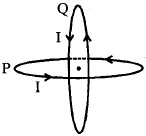
Two identical circular wires P and Q each of radius R and carrying current 'I' are kept in perpendicular planes such that they have a common centre as shown in the figure. Find the magnitude and direction of the net magnetic field at the common centre of the two coils.
Find the dimensions of:
  1. The specific heat capacity c.
  2. The coefficient of linear expansion a.
  3. The gas constant R.
Some of the equations involving these quantities are$\text{Q = mc(T}_2-\text{T}_1),\text{l}_{\text{t}}=\text{l}_0[1+\alpha(\text{T}_2-\text{T}_1)]$ and $\text{PV = nRT}.$
Explain the change in the Energy gap of an intrinsic semiconductor, with temperature
The force acting on a particle moving along X-axis is $F = -k(x - u_0t)$ where k is a positive constant. An observer moving at a constant velocity $v_0$, along the X-axis looks at the particle. What kind of motion does he find for the particle?
Can the potential function have a maximum or minimum in free space?