Question
Explain the difference between electric potential and electrical potential energy and explain the relationship between them.

Answer

Electric potential is the work done in bringing a unit positive charge from infinity without acceleration, whereas electrical potential energy is the work done in bringing the given charges from infinity to their position
Electric potential,
$V =\frac{1}{4 \pi \in_0}\left(\frac{q_1}{r}\right)$ and $U =\frac{1}{4 \pi \in_0}\left(\frac{q_1 q_2}{r}\right)$
Where symbols have general meanings. It is clear from the above expressions that
$U =\frac{1}{4 \pi \in_0}\left(\frac{q_1}{r}\right)-q_2$
$ U=q_2 . V $
Therefore, the potential energy of a system made up of $q_1$ and $q_2$ charges (which are placed at a distance $r$ from each other) is $U =$ charge $q_2 \times$ (potential at position $q_2$ due to charge $q_1$ ).

Need a full question paper?

Generate a complete, print-ready paper with questions like this in minutes — across 16+ boards, with answer keys.
Start Generating Free

Similar questions

Explain the concept of hole in intrinsic semiconductors.
A simple microscope is rated 5 for a normal relaxed eye. What will be its magnifying power for a relaxed farsighted eye whose near point is 40cm?
Explain the refraction by two transparent spherically curved surface.
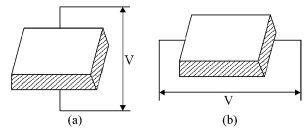
In a given figure, a rectangular object is shown. Its length is I, breadth is 0.5 I and thickness 0.25 I . To measure its resistance, potential difference $V$ is applied in two ways [figure (a) and (b)]. In which arrangement, the resistance of the substance will be more?
Image
A conducting loop of face-area A and resistance R is placed perpendicular to a magnetic field B. The loop is withdrawn completely from the field. Find the charge which flows through any cross-section of the wire in the process. Note that it is independent of the shape of the loop as well as the way it is withdrawn.
Answer the following questions:
A steady current flows in a metallic conductor of non-uniform cross-section. Which of these quantities is constant along the conductor: current, current density, electric field, drift speed?
Find the intensity at a point on a screen in Young’s double slit experiment where the interfering waves of equal intensity have a path difference of (i) $\lambda/4$, and (ii) $\lambda/3$.
Two crystals $C _1$ and $C _2$, made of pure silicon, are doped with arsenic and aluminium respectively.
a. Identify the extrinsic semiconductors so formed.
b. Why is doping of intrinsic semiconductors necessary?
Write characteristics of electro magnetic waves.
When an electron in hydrogen atom jumps from the third excited state to the ground state, how would the de Broglie wavelength associated with the electron change? Justify your answer.