Question
Explain the difference between ligament and tendon.

Answer

Differences between Ligament and Tendon :
S.No.LigamentsTends
1. Ligaments are   elastic. Tendons are inelastic.
2. Ligaments connect bones to bones at joints. Tendons connect muscles to bones.
3. Ligaments consist of yellow fibres. Tendons consist of white fibres.
4. Ligaments prevent bones from moving out of their place. Tendons assist in movement.

Need a full question paper?

Generate a complete, print-ready paper with questions like this in minutes — across 16+ boards, with answer keys.

Start Generating Free

Similar questions

Bryophyta (bryophytes) A division of plants which for some authors includes the mosses (Musci) and liverworts (Hepaticae), but is now often taken to include only the mosses; liverworts having been assigned divisional status as Hepatophyta. Bryophytes differ from algae in that the multicellular gametangium is surrounded by a protective jacket of sterile cells; gametangia of algae are usually unicellular and never have a protective jacket of sterile cells. Although bryophytes lack differentiated water-conducting vessels, and rely largely or entirely on water absorbed from rain falling on the plants, or from a moist atmosphere, some larger species may have simple water-conducting cells. They lack true roots, but possess root-like rhizoids which anchor them to a substrate and which can absorb water and minerals. The plants all show a heteromorphic alternation of generations, with a green vegetative gametophyte (the familiar moss or liverwort plant) and a sporophyte which typically takes the form of a (usually stalked) capsule and which is partially or wholly parasitic on the gametophyte. Most bryophytes are land plants and are found worldwide in a range of habitats. They are known from Devonian rocks, but there is no evidence to link them with either the green algae or the more advanced pteridophytes.

(1) A characteristic feature of bryophytes is:
(a) a dominant and parasitic sporophyte
(b) a dominant and spore-producing gametophyte
(c) a small sporophyte phase, which is dependent on the gametophyte
(d) sporophytes stay for a longer duration.

(2) Find the true statement about bryophytes:
(a) they have chloroplasts
(b) they have archegonia
(c) they are thalloid
(d) all of the above.

(3) Among the following which is not characteristics feature of bryophyte:
(a) Motile sperms
(b) Presence of archegonium
(c) Water essential for fertilization
(d) Independent sporophyte

(4) Bryophytes differ from pteridophytes in:
(a) Swimming antherozoids
(b) An independent gametophyte
(c) Archegonia
(d) Lack of vascular tissue

(5) In bryophytes, antherozoids are-
(a) Biflagellate
(b) Multiflagellate
(c) Sometimes biflagellate and sometimes multiflagellate.
(d) Biflagellate in a few species and multiflagellate in the rest.
Write short notes on the function of the following hormone :
Parathyroid hormone (PTH)
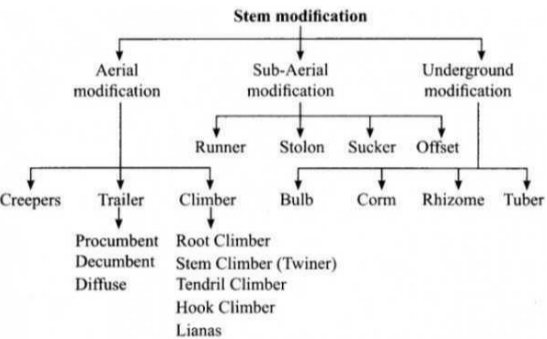
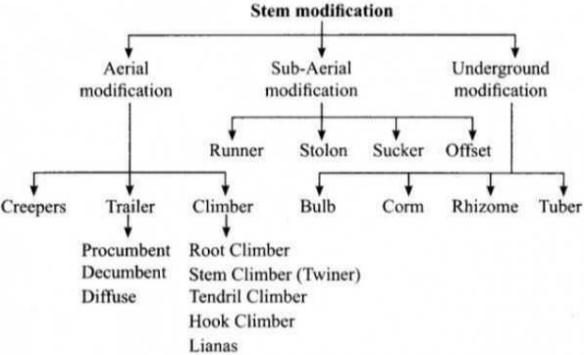
Various parts of the plant such as stems leaves, and even fruits are modified into underground parts to perform various functions such as stems, leaves, and even fruits.
The stems in ginger and banana are underground and swollen due to storage of food. They are called rhizome. Rhizome of ginger is a modification of stem because it bears nodes, internodes, terminal buds, scaly leaves and buds, which give rise to aerial shoots. It is not a root because root does not have nodes and internodes. Also, rhizome does not perform the function of roots i.e. anchorage and absorption, rather it serve as reservoir for storage of food. Similarly, corm is an underground stem in Colocasia (jimikand) The tips of the underground stem in potato become swollen due to accumulation of food and forms tuber.

Image

i. Observe the given flow chart and mention what are the four types of Underground stem modification also mention one example of each. (1)
ii. Ginger is an underground stem but why it is distinguished from a root? (1)
iii. Why do the tips of modified stems in potatoes become swollen? (2)

OR

Are all underground parts of a plant roots? (2)
Briefly describe any four valves found in the human heart. Make labelled diagram of a cross section of a human heart.
Briefly describe the structure of the Brain.
Give a brief account of viruses with respect to their structure and nature of genetic material. Also name four common viral diseases.