Question
Explain the difference between "Shift of Supply Curve" and "Movement along Supply Curve". State one factor responsible for each. Use diagrams.
Answer

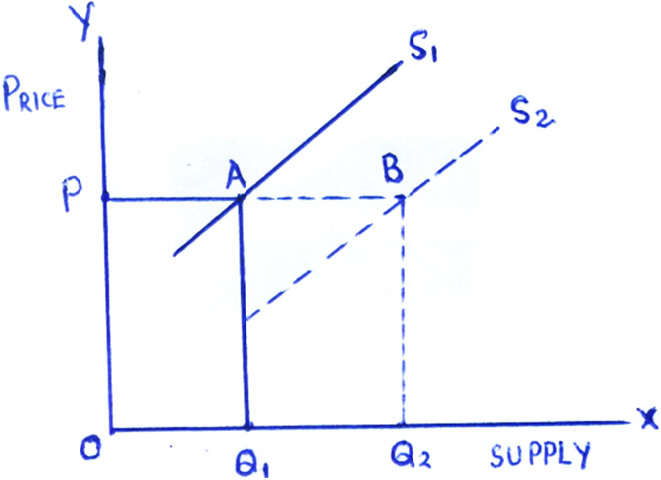
 Shift of supply curve takes place when there is a change in supply due to a factor other than own-price of the good. For example, suppose tax rate on the good is reduced. This reduces cost and shifts the supply curve from S1 to S2. Price remaining unchanged. Supply increases from OQ1 to OQ2.

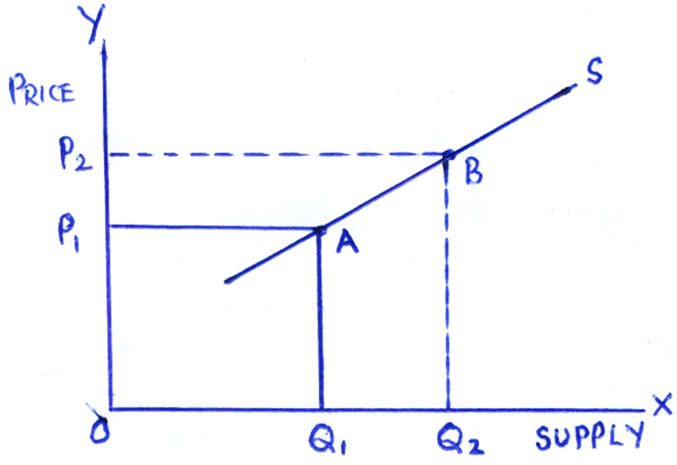
Movement along the supply curve takes place when there is change in own price of the good. Suppose own price rises, this expands supply. The change is shown along the same supply curve S, from A to B leading to change in quantity supplied from OQ1 to OQ2.
Need a full question paper?

Generate a complete, print-ready paper with questions like this in minutes — across 16+ boards, with answer keys.

Start Generating Free

Similar questions

Explain the process of money creation by the commercial banks with the help of a numerical example.
Calculate TR and AR at each level of output.
Output(Units) MR(₹) TR(₹) AR(₹)
1 10 -- --
2 8 -- --
3 0 -- --
4 -2 -- --
Suppose there are three consumers in a particular market: Ashok, Mohan and Jay. Their demand schedules are given in the following table:
Price
Quantity Demanded by Ashok
Quantity Demanded by Mohan
Quantity Demanded by Jay
1
60
55
24
2
50
40
13
3
40
25
5
4
30
10
0
5
20
0
0
  1. Derive the market demand schedule.
  2. Suppose Mohan drops out of the market. Derive the new market demand schedule.
  3. Suppose Mohan stays in the market and another person, Bhim, joins the market, whose quantity demanded at any given price is half of that of Ashok. Derive the new market demand schedule.
Calculate Net Domestic Product at Factor Cost and Private Income:
    (₹ crore)
(i) Gross National Disposable Income 600
(ii) Net current transfers to abroad (–) 20
(iii) Consumption of fixed capital 60
(iv) Current transfers from government 30
(v) Indirect tax 100
(vi) Income accruing to government 80
(vii) Subsidies 10
(viii) Net factor income to abroad (–) 10
(ix) National debt interest 40
(x) Personal tax 150
What conditions must hold if a profit-maximising firm produces positive output in a competitive market?
What is 'excess demand'? Explain the role of 'Reverse Repo Rate' in removing it.
On the basis of the following schedule, calculate Price Elasticity of Demand by percentage method.
Price per unit (₹)
Total expenditure (₹)
10
180
9
162
The following table gives the total cost schedule of a firm. It is also given that the average fixed cost at 4 units of output is Rs 5. Find the TVC, TFC, AVC, AFC, SAC and SMC schedules of the firm for the corresponding values of output.
Q
TC
1
2
3
4
5
6
50
65
75
95
130
185
Explain the problem of double counting in the estimation of national income with the help of an example. State two methods of avoiding it.
State three characteristics of monopolistic competition. Which of the characteristics separates it from perfect competition and why?