Question
Explain the difference between thermoplastics and thermosetting plastics.

Answer

Thermoplastics: The plastics which gets deformed easily on heating and can be bent easily are called thermoplastics. For example, polythene and PVC are thermoplastics. These are used in the manufacturing of toys, combs and different types of containers. Thermosetting plastics: The plastics which when molded once, cannot be softened by heating are called thermosetting plastics. For example, Bakelite is a thermosetting plastic which is a poor conductor of heat and electricity. It is used to make electrical switches and handles of utensils. Melamine is a thermosetting plastic which is resistant to fire and can tolerate heat better than other plastics. It is used to make floor tiles, kitchenware and fire-resistant fabrics.
Need a full question paper?

Generate a complete, print-ready paper with questions like this in minutes — across 16+ boards, with answer keys.

Start Generating Free

Similar questions

How are weeds removed from the crop fields? Name one implement used for weeding.
Pooja was happy when she gave birth to her second child. Her in-laws were dissatisfied with her not giving birth to a male child and blamed her. Pooja tried to convince her in-laws that she had no role in the child's gender. They were yet not satisfied. Pooja's husband took up the matter and explained them the biological reason. They understood and apologised.
(i) What are sex chromosomes ?
(ii) Is it right to blame mother for the child's gender ? Give reason for your answer.
When a lot of dry powder of a substance $X$ is released over a fire, the fire gets extinguished.
$a.$ Name the substance $X.$
$b.$ How does this substance extinguish the fire?
$c.$ Name another susbtance which behaves like $X.$
Do all the stars in the sky move? Explain.
Name any two sources which causes air pollution due to Suspended Particulate Matter $(\text{SPM}).$
What is Ganga Action Plan? When and why was it launched?
Give two examples each of:
$a.$ Solid fuels.
$b.$ Liquid fuels.
$c.$ Gaseous fuels.
Resultant forces considered in following situations
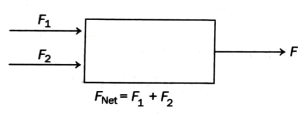
(i) If the two forces act in the same direction on a body, the net force acting on it is the sum of two forces.
Image
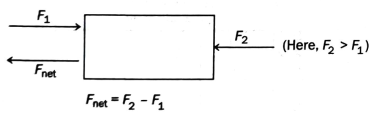
(ii) If the two forces act in the opposite directions on a body, the net force acting on it is the difference between two forces.
Image
Suppose, two forces of 15 N and 30 N act on a body from the left hand side, while another force of 35 N acts on it from the right hand side. Find the resultant of the force and its direction.
A beaker contains an acidified copper sulphate solution. A copper plate and a carbon rod are kept in this copper sulphate solution. The copper plate is connected to the positive terminal of a battery whereas the carbon rod is connected to the negative terminal of the battery. What will you observe when an electric current is passed through this set-up for a considerable time?
In what ways, wildlife conservation and forest conservation are related?