Gujarat BoardEnglish MediumSTD 12 ScienceBIOLOGYMolecular Basis of Inheritance3 Marks
Question
Explain the double helix structure of $ \text{DNA}$
✓
Answer
$\rightarrow$ $ \text{DNA}$ as an acidic substance present in nucleus was first identified by Friedrich Meischer in $1869.$ He named it as 'Nuclein'.
$\rightarrow$ However, due to technical limitation in isolating such a long polymer intact, the elucidation of structure of $ \text{DNA}$ remained elusive for a very long period of time.
$\rightarrow$ It was only in $1953$ that James Watson and Francis Crick, based on the $X-$ray diffraction data produced by Maurice Wilkins and Rosalind Franklin, proposed a very simple but famous $[$Double Helix$]$ model for the structure of $ \text{DNA}$.
$\rightarrow$ One of the hallmarks of their proposition was base pairing between the two strands of polynucleotide chains.
$\rightarrow$ However, this proposition was also based on the observation of Erwin Chargaff that for a double stranded $ \text{DNA}$, the ratios between Adenine and Thymine and Guanine and Cytosine are constant and equals one.
$\rightarrow$ The base pairing confers a very unique property to the polynucleotide chains.
$\rightarrow$ They are said to be complementary to each other, and therefore if the sequence of bases in one strand is known then the sequence in other strand can be predicted.
$\rightarrow$ Also, if each strand from a $ \text{DNA}$ $($let us call it as a parental $ \text{DNA}$$)$ acts as a template for synthesis of a new strand, the two double stranded $ \text{DNA}$ $($let us call them as daughter $ \text{DNA}$$)$ thus, produced would be identical to the parental $ \text{DNA}$ molecule.
$\rightarrow$ Because of this, the genetic implications of the structure of $ \text{DNA}$ became very clear
$\rightarrow$ The salient features of the Double$-$helix structure of $ \text{DNA}$ are as follows:
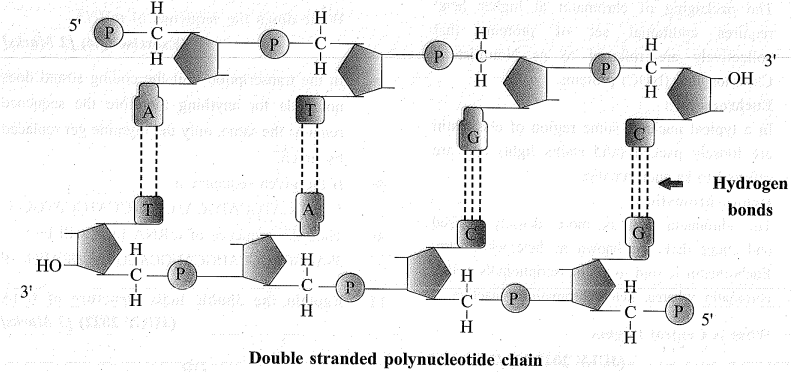
$(i)$ It is made of two polynucleotide chains, where the backbone is constituted by sugar-phosphate, and the bases project inside.
$(ii)$ The two chains have anti-parallel polarity. It means, if one chain has the polarity $5\ '$ $\rightarrow$ $3\ ',$ the other has $3\ '$ $\rightarrow$ $5\ '.$
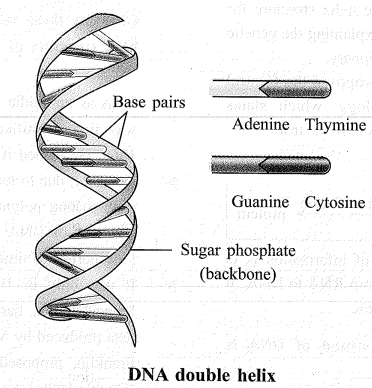
$(iii)$ The bases in two strands are paired through hydrogen bond $(H-$bonds$)$ forming base pairs $(bp).$ Adenine forms two hydrogen bonds with Thymine from opposite strand and vice$-$versa. Similarly, Guanine is bonded with Cytosine with three $H-$bonds. As a result, a purine always comes opposite to a pyrimidine. This generates approximately uniform distance between the two strands of the helix as shown $($Figure$).$
$(iv)$ The two chains are coiled in a right$-$handed fashion. The pitch of the helix is $3.4 \ nm \ ($a nanometre is one billionth of a metre, that is $10^{-9}m)$ and there are roughly $10 \ bp$ in each turn. Consequently, the distance between a bp in a helix is approximately $0.34 \ nm.$
$(v)$ The plane of one base pair stacks over the other in double helix. This, in addition to $H-$bonds, confers stability of the helical structure $($Figure$).$
Need a full question paper?
Generate a complete, print-ready paper with questions like this in minutes — across 16+ boards, with answer keys.