Question
Explain the effect of electric potential (potential difference) on photoelectric current and derive the definition and formula of stopping potential.
Answer

Initially, plate C is illuminated with light keeping plate A at positive potential with respect to plate C and keeping the frequency (v) and intensity (I) of incident light constant. Due to the positive potential of $A$, some of the emitted photo electrons are attracted towards, plate A and form a photocurrent.
Now if the magnitude (value) of the positive potential of A is increased then more and more emitted electrons are attracted to A and form more photocurrent. Thus, photocurrent increases with voltage.
After some time, all the electrons emitted from plate C are collected by plate A and form the maximum photocurrent in the circuit. This value of current is saturated (maximum), meaning that on increasing the potential no longer increase the photocurrent. This maximum value of the photocurrent is called saturation current.
• Stopping Potential :
Now apply a negative potential to the plate A with respect to the plate $C$.
By doing this the electrons emitted from C will be repelled by A , so the electrons that have enough energy to overcome the repulsion of A will reach A and form a current in the circuit, so the photocurrent will decrease.
Now if the negative potential of A is increased i.e. made more negative, more and more electrons will be repelled and the number of electrons falling on A will decrease, so the photocurrent will also decrease rapidly.
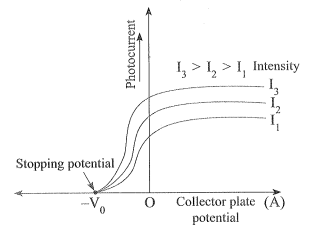
For some minimum value of the negative potential of A , all electrons arriving at A will be stopped. i.e. the photocurrent in the circuit will be zero. This minimum value of negative potential of A is called the stopping potential or cut-off voltage.
Each electron emitted from C has a different energy (kinetic energy), so if the electron with the maximum kinetic energy is stopped by the repulsion of the plate A , all the electrons are stopped and the photocurrent in the circuit is stopped.
Suppose, maximum kinetic energy of electron is $K _{\max }$.
The energy provided by the repulsion of A to stop this electron $=e V_0$
Thus, photocurrent stops if $K _{\max }=e V_0$.
Here the voltage $V _0$ will be the stopping potential or cut-off voltage.
Image
Now keeping the frequency of the incident light constant and increasing its intensity (i.e. intensity $I_2$ then $I _3$, where $I _3> I _2> I _1$ ) a graph of photocurrent versus collector plate can be drawn.
It is clear from this graph that by increasing the intensity of light the value of the maximum saturated photocurrent increases, So $I =\frac{q}{t}=$ $\frac{n e}{t}$ as the number of electrons emitted in 1 sec increases by $\left(\frac{n}{t}\right)$, but the value of the stopping potential does not change, so it can be said from
$K _{\max }=e V_0$, the maximum kinetic energy of emitted photoelectrons does not depend on the intensity of incident light.
$K _{\max }$ does not depend on the intensity of incident radiation.

Need a full question paper?

Generate a complete, print-ready paper with questions like this in minutes — across 16+ boards, with answer keys.
Start Generating Free

Similar questions

A certain sample of a radioactive material decays at the rate of 500 per second at a certain time. The count rate falls to 200 per second after 50 minutes.
  1. What is the decay constant of the sample?
  2. What is its half-life?
Explain the difficulties occurred by using galvanometer directly as ammeter.
The drift current in a reverse-biased p-n junction increases in magnitude if the temperatu,re of the junction is increased. Explain this on the basis of creation of hole-electron pairs.
Derive the formula for conductivity and resistivity of metals by obtaining the relationship between drift velocity and current density.
In actual transformers, small energy losses do occur. Give reason for it and how it can be reduce. (Any three)
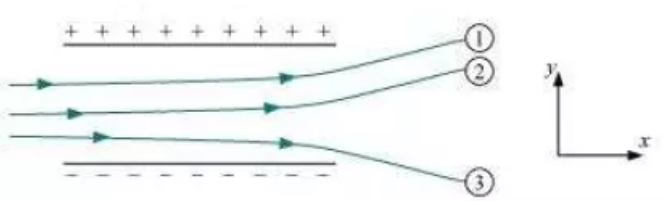
Figure 1.33 shows tracks of three charged particles in a uniform electrostatic field. Give the signs of the three charges. Which particle has the highest charge to mass ratio?

Two insulating small spheres are rubbed against each other and placed 1cm apart. If they attract each other with a force of 0.1N, how many electrons were transferred from one sphere to the other dunng rubbing?
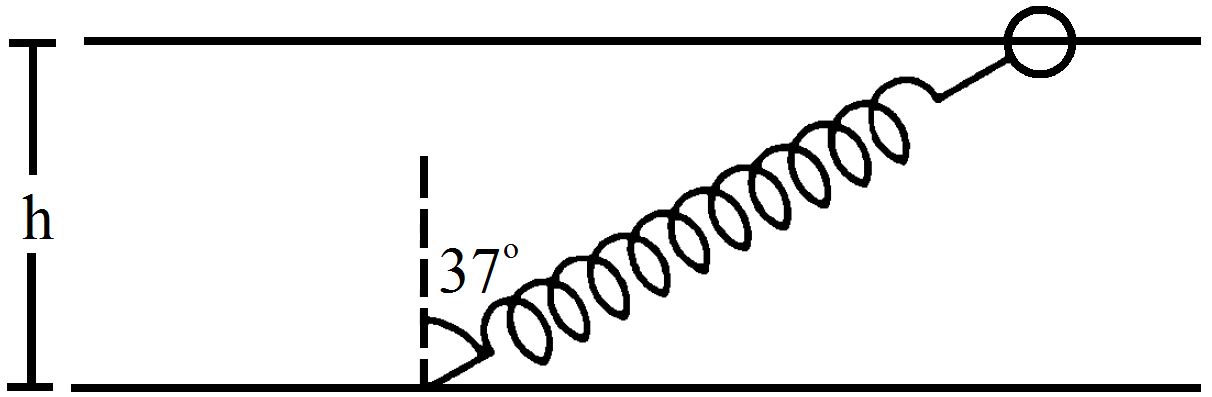
One end of a spring of natural length h and spring constant k is fixed at the ground and the other is fitted with a smooth ring of mass m which is allowed to slide on a horizontal rod fixed at a height h (figure). Initially, the spring makes an angle of 37° with the vertical when the system is released from rest. Find the speed of the ring when the spring becomes vertical.

Calculate the number of photons emitted per second by a 10W sodium vapour lamp. Assume that 60% of the consumed energy is converted into light. Wavelength of sodium light = 590nm.
The current through a wire depends on time as $\text{i}=\text{i}_0+\alpha\text{t},$
Where $\text{i}_0=10\text{A}$ and $\alpha=4\text{A/ s}.$ Find the charge that crosses through a section of the wire in 10 seconds.