DUAL NATURE OF RADIATION AND MATTER — Physics STD 12 Science — Question
Bihar BoardEnglish MediumSTD 12 SciencePhysicsDUAL NATURE OF RADIATION AND MATTER2 Marks
Question
Explain the effect of intersity of light on photocurrent.
✓
Answer
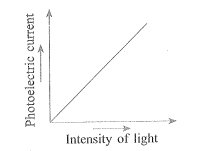
→In an experimental arrangement of the photoelectric effect the collector A is maintained at a positive potential with respect to photosensitive plate C . →The potential difference between A and C and the frequency of the incident light is kept constant. →The intensity of incident light is changed. →When light is incident on plate C , electrons are emitted from it and these are attracted by plate A to form a photocurrent. →The magnitude of photocurrent obtained for different light intensities is measured with a microammeter and a graph of photocurrent versus intensity is drawn. →The straight line of graph suggests that the photocurrent is directly proportional to the intensity of incident light. →Now, current $I =\frac{q}{t}$ $\therefore I =\frac{n e}{t} \quad(\because q=n e)$ BDkt, $n=$ Number of electrons $e=$ Charge of electron $\therefore \quad I \propto \frac{n}{t} \quad(\because e$ is constant $)$ →Thus, the current (photocurrent) is directly proportional to the number of photoelectrons emitted per unit time. →From this it can be said that the number of photoelectrons emitted per unit time (one second) is directly proportional to the intensity of incident radiation. Photocurrent $\propto$ Intensity Photocurrent $\propto$ number of electrons per unit time. (Number of electrons emitted per unit time) $\propto$ (Intensity)
Need a full question paper?
Generate a complete, print-ready paper with questions like this in minutes — across 16+ boards, with answer keys.