Question
Explain the excited states for the hydrogen atom.

Answer


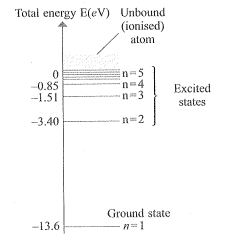
Image
At room temperature, most of the hydrogen atoms are in ground state.
When a hydrogen atom receives energy by processes such as electron collisions, the atom may acquire sufficient energy to raise the
electron to higher energy states. The atom is then said to be in an excited state.
Putting $n=2$ in
$\begin{array}{l} 
E _{ n }=-\frac{13.6}{n^2} e V \\
E _2=-3.4 e V .
\end{array}$
It means that the energy required to excite an electron in hydrogen atom to its first excited state, is an energy equal to
$\begin{aligned}
E _2- E _1 & =-3.40 eV -(-13.6) eV \\
& =-3.4 eV +13.6 eV \\
& =10.2 eV
\end{aligned}$
Similarly, $E _3=-1.51 eV$
To excite the hydrogen atom from its ground state to second excited state, energy required is
$\begin{aligned}
E _3- E _1 & =-1.51 eV -(-13.6) eV \\
& =-1.51 eV +13.6 eV \\
& =12.09 eV
\end{aligned}$
In contrast, when an electron moves from an excited state to a lower energy state a photon is emitted.
Thus, as the excitation of hydrogen atom increases (as $n$ increases) the value of minimum energy required to free the electron from the excited atom decreases.
The energies of the excited states come closer and closer together as $n$ increases.

Need a full question paper?

Generate a complete, print-ready paper with questions like this in minutes — across 16+ boards, with answer keys.
Start Generating Free

Similar questions

The separation between the consecutive dark fringes in a Young's double slit experiment is 1.0mm. The screen is placed at a distance of 2.5m from the slits and the separation between the slits is 1.0mm. Calculate the wavelength of light used for the experiment.
Draw the output waveform at X, using the given inputs A and B for the logic circuit shown below. Also, identify the logic operation performed by this circuit.

Current in a circuit falls from 5.0 A to 0.0 A in 0.1 s. If an average emf of 200 V induced, give an estimate of the self-inductance of the coil.
Consider a small cube of volume 1mm3 at the centre of a circular loop of radius 10cm carrying a current of 4A. Find the magnetic energy stored inside the cube.
Answer the following:
The discharging current in the atmosphere due to the small conductivity of air is known to be 1800A on an average over the globe. Why then does the atmosphere not discharge itself completely in due course and become electrically neutral? In other words, what keeps the atmosphere charged?
Can you ever have a situation in which a light ray goes undeviated through a prism?
Why does current in a steady state not flow in a capacitor connected across a battery? However momentary current does flow during charging or discharging of the capacitor. Explain.
Suppose, in certain conditions only those transitions are allowed to hydrogen atoms in which the principal quantum number n changes by 2. (a) Find the smallest wavelength emitted by hydrogen. (b) List the wavelength emitted by hydrogen in the visible range (380nm to 780nm).
A pivoted aluminium bar falls much more slowly through a small region containing a magnetic field than a similar bar of an insulating material. Explain.
If current flowing in a circular coil is doubled and radius is halved, then what would be the change in the produced magnetic field at the center of the coil?