Question
Explain the experiments of Faraday and Henry for explaining and describing the phenomenon of electromagnetic induction.
Answer

SELF

Need a full question paper?

Generate a complete, print-ready paper with questions like this in minutes — across 16+ boards, with answer keys.

Start Generating Free

Similar questions

Consider a metal ring kept (supported by a cardboard) on top of a fixed solenoid carrying a current I (see Fig). The centre of the ring coincides with the axis of the solenoid. If the current in the solenoid is switched off, what will happen to the ring?
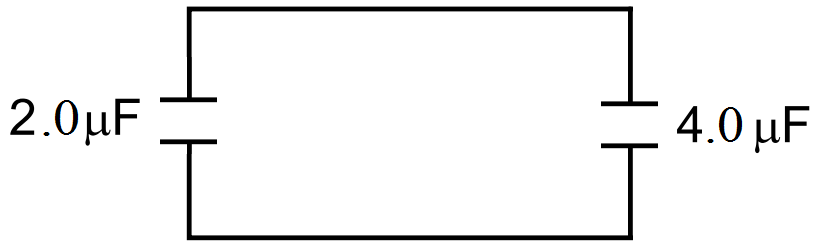
A capacitor of capacitance $2.0\mu\text{F}$ is charged to a potential difference of $12V.$ It is then connected to an uncharged capacitor of capacitance $4.0\mu\text{F}$ as shown in figure. Find:
  1. The charge on each of the two capacitors after the connection.
  2. The electrostatic energy stored in each of the two capacitors.
  3. The heat produced during the charge transfer from one capacitor to the other.
Four particles of equal masses M move along a circle of radius R under the action of their mutual gravitational attraction. Find the speed of each particle.
A sound wave of frequency 100Hz is travelling in air. The speed of sound in air is 350m/s.
  1. By how much is the phase changed at a given point in 2.5ms?
  2. What is the phase difference at a given instant between two points separated by a distance of 10.0cm along the direction of propagation?
An electron of kinetic energy 100eV circulates in a path of radius 10cm in a magnetic field. Find the magnetic field and the number of revolutions per second made by the electron.
Two coils $A$ and $B$ have inductances $1.0H$ and $2.0H$ respectively. The resistance of each coil is $10\Omega.$ Each coil is connected to an ideal battery of emf $2.0V$ at $t = 0$ Let $i_A$ and $i_B$ be the currents in the two circuit at time $t$. Find the ratio $\frac{\text{i}_\text{A}}{\text{i}_\text{B}}$
  1. $t = 100ms$
  2. $t = 200ms$
  3. $t = 1s.$
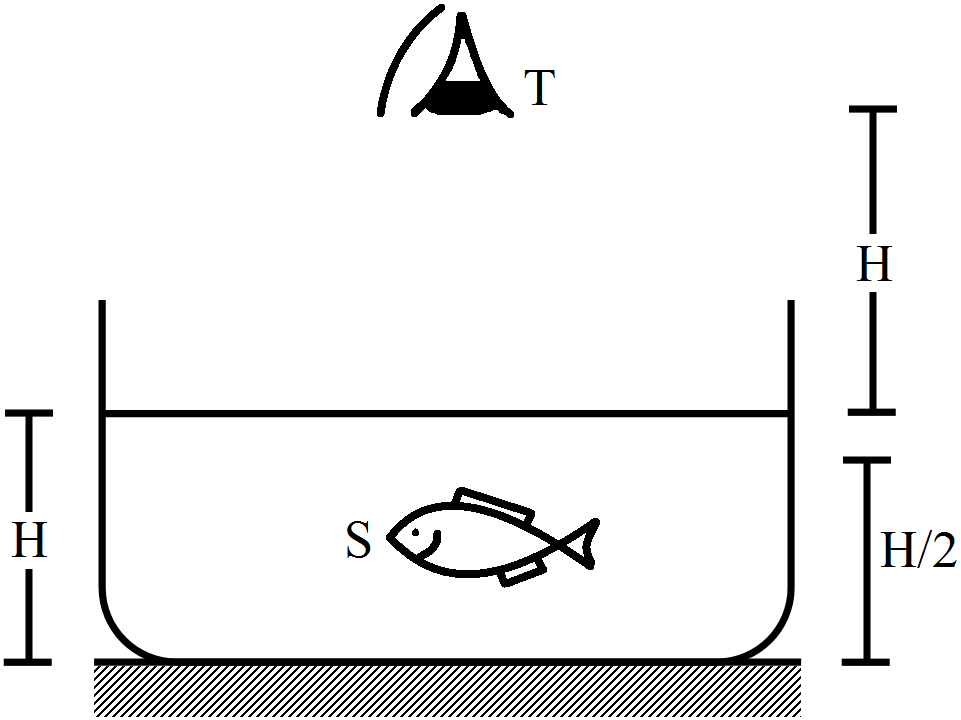
Consider the situation in figure. The bottom of the pot is a reflecting plane mirror, S is a small fish and T is a human eye. Refractive index of water is.
  1. At what distance(s) from itself will the fish see the image(s) of the eye?
  2. At what distance(s) from itself will the eye see the image(s) of the fish.
What are N-type semiconductors? Their conductivity is higher than that of pure semiconductors. Why? Explain with figure.
A particle with a charge of $5.0 µC$ and a mass of $5.0 \times 10^{-12}kg$ is projected with a speed of $1.0\ km s^{-1}$ in a magnetic field of magnitude $5.0mT.$ The angle between the magnetic field and the velocity is $\sin^{-1} (0.90).$ Show that the path of the particle will be a helix. Find the diameter of the helix and its pitch.
The relaxation time $τ$ is nearly independent of applied $E$ field whereas it changes significantly with temperature $T.$ First fact is $($in part$)$ responsible for Ohm’s law whereas the second fact leads to variation of $\rho$ with temperature. Elaborate why?