Question
Explain the following:
  1. Eutrophication.
  2. Biomagnification.

Answer

  1. Eutrophication is nutrient enrichment (i.e., addition of nitrates and phosphates) of water body that results in the growth of aquatic plants, especially algae causing colouration of water known as algal bloom. It leads to depletion of dissolved oxygen in water resulting in killing of aquatic organisms (e.g., fish).
  2. The phenomenon of increase in the concentration of harmful non-biodegradable substances in the body of living organisms at each trophic level of the food chain is called biomagnification. Two heavy metals which are biomagnified are mercury and cadmium. Due to biomagnification fish-eating predatory birds such as kingfishers and loon become poisoned.

Need a full question paper?

Generate a complete, print-ready paper with questions like this in minutes — across 16+ boards, with answer keys.
Start Generating Free

Similar questions

State Newton’s third law of motion and give two examples to illustrate the law.
  1. Draw a neat diagram of Hydra.
  2. Label mesoglea and gastrovascular cavity.
  3. Name the group of animals it belongs to.
  4. Name one species of this group that lives in colonies.
Raunak took $5$ moles of carbon atoms in a container and Krish also took $5$ moles of sodium atoms in another container of same weight.
  1. Whose container is heavier?
  2. Whose container has more number of atoms?
Explain main functional regions of a cell with the help of a diagram.
Explain the mechanism of compost formation.
A boy walks from his classroom to the bookshop along a straight corridor towards North. He covers a distance of $20m$ in $25$ seconds to reach the bookshop. After buying a book, he travels the same distance in the same time to reach back in the classroom. Find $(a)$ average speed, and $(b)$ average velocity, of the boy.
How are sol, solution and suspension different from each other?
Derive an expression for the force of attraction between two bodies and then define gravitational constant.

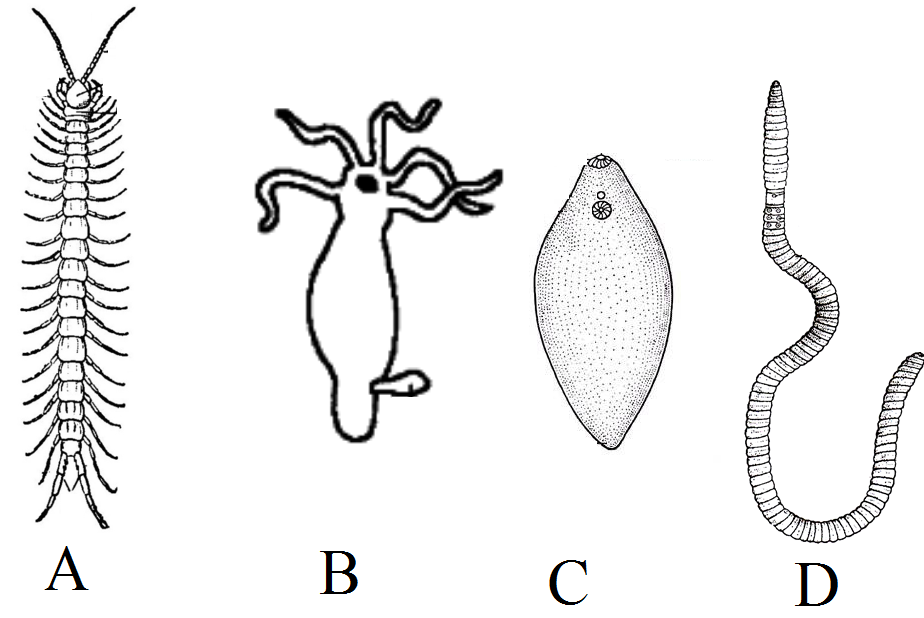
  1. Identify figure $A$ to $D.$
  2. Which one of them is $(i)$ diplobalstic; $(ii)$ Coelomate$?$
  3. Which triplobalstic animal is $(i)$ Acoelomate; $(ii)$ Coelomate$?$
  4. Which one belong to phylum $(i)$ Cnidaria; $(ii)$ Platyhelminthes; $(iii)$ Annelids; $(iv)$ Arthropoda$?$
  5. Which one of them has $(i)$ Organ level organization$?\ (ii)$ Organ system level organization$?$
  6. Which one of them has excretory organs in the form of $(i)$ Flame cells; $(ii)$ Nephridia$?$
  7. Which one of them has trachea as the respiratory organ$?$
What is momentum$?$ Write its $SI$ unit. Interpret force in terms of momentum. Represent the following graphically
  1. momentum versus velocity when mass is fixed.
  2. momentum versus mass when velocity is constant.