Question
Explain the following giving examples.
Saturated solution.

Answer

A saturated solution is a solution in which the maximum amount of solute has been dissolved at a given temperature. The solution cannot dissolve beyond that amount of solute at that temperature. Any more solute added will settle down at the bottom of the container as a precipitate.
Suppose 500g of a solvent can dissolve a maximum of 150g of a particular solute at 40°C. Then, the solution obtained by dissolving 150g of that solute in 500g of that solvent at 300K is said to be a saturated solution at 300K.

Need a full question paper?

Generate a complete, print-ready paper with questions like this in minutes — across 16+ boards, with answer keys.
Start Generating Free

Similar questions

Summarise the rules for writing of distribution of electrons in various shells for the first eighteen elements.
A solution contains 50mL of alcohol mixed with 150mL of water. Calculate the concentration of this solution.
Identify the total number of inert gases, their names and symbols from this cross word puzzle.
What is the number of zinc atoms in a piece of zinc weighing 10g?
(Atomic mass of Zn = 65u)
Explain why, osmosis can be considered to be a special kind of diffusion. Classify the following into (i) osmosis, and (ii) diffusion:
  1. Swelling up of a raisin on keeping in water.
  2. Spreading of virus on sneezing.
  3. Earthworm dying on coming in contact with common salt.
  4. Shrinking of grapes kept in thick sugar syrup.
  5. Preserving of pickles in salt.
  6. Spreading of smell of cake being baked in the kitchen.
  7. Aquatic animals using oxygen dissolved in water during respiration.
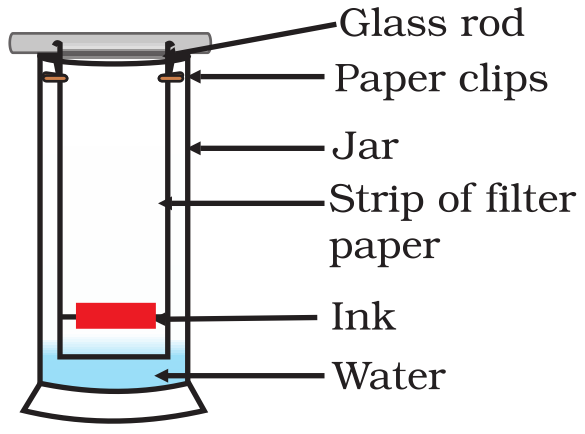
A child wanted to separate the mixture of dyes constituting a sample of ink. He marked a line by the ink on the filter paper and placed the filter paper in a glass containing water as shown in the filter paper was removed when the water moved near the top of the filter paper.


  1. What would you expect to see, if the ink contains three different coloured components?
  2. Name the technique used by the child.
  3. Suggest one more application of this technique.
Differentiate between homogeneous and heterogeneous mixtures with examples.
Potassium chlorate decomposes, on heating, to form potassium chloride and oxygen. When 24.5g of potassium chlorate is decomposed completely, then 14.9g of potassium chloride is formed. Calculate the mass of oxygen formed. Which law of chemical combination have you used in solving this problem?
Calculate the number of molecules in 4g of oxygen.
How will you demonstrate that water vapour is present in air?