Question
Explain the following items:
Avitaminosis.

Answer

Avitaminosis: Lack of more than one vitamin causes multiple deficiency diseases called avitaminosis.

Need a full question paper?

Generate a complete, print-ready paper with questions like this in minutes — across 16+ boards, with answer keys.
Start Generating Free

Similar questions

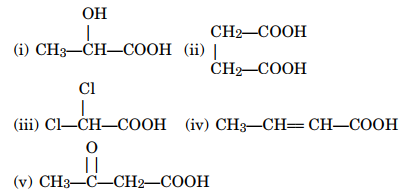
Write IUPAC names of the following:
Image
Give the structure of A, B and C in the following reaction:$\text{CH}_3\text{CH}_2\text{I}\xrightarrow[]{\text{NaCN}}\text{A}\xrightarrow[\text{Partial hydolysis}]{\text{OH}^+}\text{B}\xrightarrow[]{\text{NaOH}+\text{Br}_2}\text{C}$
When 3-methylbutan-2-ol is treated with HBr, the following reaction takes place:$\ \ \ \ \ \ \ \ \ \ \ \ \ \ \ \ \ \ \ \ \ \ \ \ \ \ \ \ \ \ \ \ \ \ \ \ \ \ \ \ \ \ \ \ \ \ \ \ \ \ \ \ \ \ \ \ \ \ \ \ \ \ \ \ \ \ \ \ \text{Br}\\\ \ \ \ \ \ \ \ \ \ \ \ \ \ \ \ \ \ \ \ \ \ \ \ \ \ \ \ \ \ \ \ \ \ \ \ \ \ \ \ \ \ \ \ \ \ \ \ \ \ \ \ \ \ \ \ \ \ \ \ \ \ \ \ \ \ \ \ \ |\\\text{CH}_3-\text{CH}-\text{CH}-\text{CH}_3\xrightarrow{\ \ \ \text{HBr} \ \ }\text{CH}_3-\text{C}-\text{CH}_2-\text{CH}_3\\\ \ \ \ \ \ \ \ \ \ \ \ \ \ |\ \ \ \ \ \ \ \ \ \ |\ \ \ \ \ \ \ \ \ \ \ \ \ \ \ \ \ \ \ \ \ \ \ \ \ \ \ \ \ \ \ \ \ \ \ \ \ \ \ \ \ \ \ |\\\ \ \ \ \ \ \ \ \ \ \ \ \ \text{CH}_3\ \ \ \ \text{OH}\ \ \ \ \ \ \ \ \ \ \ \ \ \ \ \ \ \ \ \ \ \ \ \ \ \ \ \ \ \ \ \ \ \ \ \ \ \ \text{CH}_3$
Give a mechanism for this reaction.
(Hint: The secondary carbocation formed in step II rearranges to a more stable tertiary carbocation by a hydride ion shift from 3rd carbon atom.)
Explain briefly how +2 state becomes more and more stable in the first half of the first row transition elements with increasing atomic number?
Write the reactions of $D-$ glucose which can’t be explained by its open $-$ chain structure. How can cyclic structure of glucose explain these reactions?
Give examples and IUPAC names of the following types of complexes :
(i) Neutral complex
(ii) Negative complex
(iii) Positive complex.
A reaction is second order with respect to a reactant. How is the rate of reaction affected if the concentration of the reactant is :
(i) doubled (ii) reduced to half ?
Write the $IUPAC$ name and draw the structure of coordination entities of $[PtCl(NH_3)_5]Cl_3.$
Give examples and suggest reasons for the following features of the transition metal chemistry:
A transition metal exhibits highest oxidation state in oxides and fluorides.
Explain reverse osmosis for purification of water.