Question
Explain the following reaction with an example.
Esterification

Answer

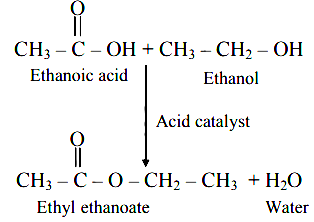
Substances having ester as the functional group are formed by a reaction between a carboxylic acid and an alcohol. This reaction is known as esterification.
E.g. When ethanoic acid is heated with ethanol in a water bath in the presence of an acid catalyst (concentrated sulphuric acid), ethyl ethanoate and water are formed.

Need a full question paper?

Generate a complete, print-ready paper with questions like this in minutes — across 16+ boards, with answer keys.

Start Generating Free

Similar questions

Calculate the focal length of a convex lens which produces a virtual image at a distance of 50cm of an object placed 20cm in front of it.
State the merits of Mendeleev's Periodic Table.
What is the nuclear fuel in the sun? Describe the process by which energy is released in the sun. Write the equation of the nuclear reaction involved.
Complete the paragraph by choosing the right options given below.
(minimum, near point, 25 cm, farthest, farthest distance, far point)
The _______ distance of an object from a normal eye, at which it is clearly visible without stress on the eye, is called the minimum distance of distinct vision. The position of the object at this distance is called the _______ of the eye, for a normal human eye, the near point is at _______. The _______ distance of an object from a human eye, at which it is clearly visible without stress on the eye is called _______ of distinct vision. The position of the object at this distance is called the _______ of the eye.
Mahendra and Virat are sitting at a distance of $1\ m$ from each other.Their masses are $75\ kg$ and $80\ kg$ respectively.
What is the gravitational force between them?
$(G = 6.67 \times 10^{-11} Nm^2/kg^2)$
Draw a neat labelled diagram.A solar panel made from 36 solar cells.
What can you see in a completely dark room? If you switch on an electric bulb in this dark room as a light source, explain how you could now see:
  1. The electric bulb.
  2. A piece of white paper.
A concave mirror has a focal length of $4\ cm$ and an object $2\ cm$ tall is placed 9cm away from it. Find the nature, position and size of the image formed.
An element $E$ forms an oxide $E_2O$. An aqueous solution of $E_2O$ turns red litmus paper blue.
  1. What is the nature of the oxide $E_2O?$
  2. State whether element $E$ is a metal or a non-metal.
  3. Give one example of an element like $E.$
How are the various processes occurring in the human body controlled? In how many ways?