Question
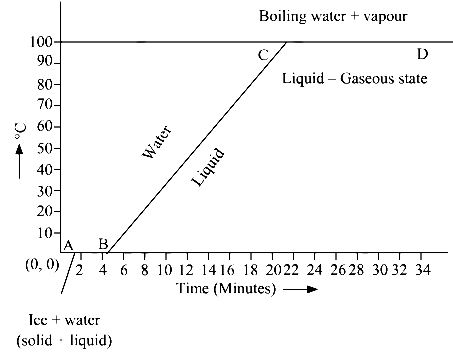
Explain the following temperature vs time graph.

Answer

 In the given graph, line $A B$ represents conversion of ice into water at constant temperature. When ice is heated, it melts at $0^{\circ} C$ and converts into water maintaining constant temperature of $0^{\circ} C$. This constant temperature, at which the ice converts into water is called the melting point of ice. Also, during this transition, the ice absorbs heat energy. This heat energy is utilised for weakening the bonds between the atoms or molecules in the ice to transform itself into liquid. This heat energy absorbed by ice, at constant temperature, to convert it into liquid is called the latent heat of fusion.
Once all the ice is transformed into water, the temperature of water starts rising. It increases upto $100^{\circ} C$. Line BC in the graph represents rise in temperature of water from $0^{\circ} C$ to $100^{\circ} C$. Thereafter, even though heat energy is supplied to water, its temperature does not rise. The heat energy is absorbed by water at this temperature and is used to break the bonds between molecules of the liquid and convert the liquid into gaseous state. Thus, during transformation from liquid phase to gas phase, heat energy is absorbed by the liquid, but its temperature does not change. The constant temperature at which the liquid transforms into gaseous state is called the boiling point of the liquid. The heat energy absorbed at constant temperature during transformation of liquid into gas is called the latent heat of vaporization.

Need a full question paper?

Generate a complete, print-ready paper with questions like this in minutes — across 16+ boards, with answer keys.

Start Generating Free

Similar questions

Write down structural formulae of the first four members of the various homologous series formed by making use of the functional groups.
The human males use a device X made of a very thin rubber sheet as a covering on the male organ to prevent pregnancy. This device traps the gametes Y in it. In order to prevent pregnancy, the human females use a device Z which is a circle of rubber with a metal spring around it. The device Z is put inside the vagina to cover the cervix. It stops Y from going into the uterus.
  1. What is device X?
  2. What are Y?
  3. Name the device Z.
  4. What is the general name of these methods of birth control (or preventing pregnancy)?
  5. The use of which contraceptive device, X or Z, can protect the persons from sexually transmitted diseases?
Renewable energy is, energy produced from sources that do not deplete or can be replenished within a human’s life time. The most common examples include wind, solar, geothermal, biorhass, and hydroelectric power. This is in contrast to non-renewable sources such as fossil fuels. Most renewable energy is derived directly or indirectly from the sun. Sunlight can be captured directly using solar technologies. The sun’s heat drives winds, whose energy is captured with turbines. Plants also rely on the sun to grow and their stored energy can be utilized for bioenergy. Not all renewable energy sources rely on the sun. For example, geothermal energy utilizes the Earth’s internal heat, tidal energy relies on the gravitational pull of the moon, and hydroelectric power relies on the flow of water.
Questions and Answers :
(1) What is renewable energy?
(2) Give the examples of renewable energy.
(3) Why will energy from fossil fuel be over soon?
(4) Name the renewable sources of energy which are not dependent on sun. What are they dependent upon?
(5) Which type of energy do we mostly use in India?
State one use each of the following metals:
Copper, Aluminium, Iron, Silver, Gold, Mercury
A person first crossed pure-bred pea plants having round-yellow seeds with pure-bred pea plants having wrinkled-green seeds and found that only $A-B$ type of seeds were produced in the $F_1$ generation. When $F_1$ generation pea plants having $A-B$ type of seeds were cross-bred by self-pollination, then in addition to the original round-yellow and wrinkled-green seeds, two new varieties $A-D$ and $C-B$ type of seeds were also obtained.
  1. What are $A-B$ type of seeds$?$
  2. State whether $A$ and $B$ are dominant traits or recessive traits.
  3. What are $A-D$ type of seeds$?$
  4. What are $C-B$ type of seeds$?$
  5. Out of $A-B$ and $A-D$ types of seeds, which one will be produced in $(i)$ minimum numbers, and $(ii)$ maximum numbers, in the $F_2$ generation?
In case of sexual reproduction, newborn shows similarities about characters. Explain this statement with suitable example.
Classify the following into herbivores, carnivores and omnivores:
Lion, Man, Dog, Goat, Crow, Elephant, Snake, Hawk, Rabbit, Deer.
Write the names of all the major endocrine glands present in the human body. Which of these glands also function as exocrine glands?
When a person eats sugary food, then organisms A present in his mouth act on sugar to produce a substance B. The substance B first dissolves the calcium salts from the top part C of the tooth and then from its middle part D forming holes E. These holes ultimately reach the part F in the lower part of tooth which contains nerves and blood vessels. The substance B irritates the nerve endings inside the tooth causing toothache.
  1. What are (i) organisms A, and (ii) substance B?
  2. What are (i) part C, and (ii) part D, of tooth known as?
  3. By what name are the holes E in the tooth known?
  4. Name the part F of the tooth.
  5. What will happen if organisms A reach part F of the tooth known?
The surface of water in a lake appears green due to a layer of tiny free-floating organisms X on its surface. The lake water also contains organisms like water beetle, fish and tadpole. The sun shines over the lake water and provides energy for the functioning of this lake ecosystem.
  1. What could organisms X be?
  2. Write a food chain comprising of all the four organisms mentioned.
  3. What is the general name of the food chains like the one written above?
  4. Name (i) secondary consumer (ii) producer (iii) tertiary consumer, and (iv) primary consumer, in the above food chain.
  5. If the tertiary consumer gets 0.2 J of energy from the secondary consumer, then how much energy was radiated by the sun to the producer?