Question
Explain the following terms:
  1. Coriolis Force.
  2. Jet Stream.
  3. Monsoon.

Answer

  1. Coriolis Force: The Coriolis force is caused due to the rotation of the earth. Because of the coriolis effect (caused due to the rotation of the earth) the winds in the Northern Hemispere gets deflected towards the right and in the Southern Hemisphere gets deflected towards left.
  2. Jet Stream: A jet stream is defined as a current of rapidly moving air that is usually several thousand miles long and wide but is relatively thin. They are found in the upper levels of Earth's atmosphere at the tropopause- the boundary between the troposphere and stratosphere (see atmospheric layers).
Jet streams are fast flowing, narrow, meandering air currents in the atmospheres of some planets, including Earth. On Earth, the main jet streams are located near the altitude of the tropopause and are westerly winds (flowing west to east). Their paths typically have a meandering shape.
  1. Monsoon: A monsoon is a seasonal change in the direction of the prevailing, or strongest, winds of a region. Monsoons cause wet and dry seasons throughout much of the tropics. Monsoons are most often associated with the Indian Ocean. Monsoons always blow from cold to warm regions.
Monsoons are measured by calculating the average rainfall or wind speed. The West African monsoon spans from June to September and is located in western Africa. The North American monsoon spans from July to September, creating storms and heavy rain in the southwestern part of the United States.

Need a full question paper?

Generate a complete, print-ready paper with questions like this in minutes — across 16+ boards, with answer keys.

Start Generating Free

Similar questions

Write briefly about anti-poverty programmes started by the government.
State the main events occurring between the February Revolution in Petrograd and the October Revolution.
Read the following answer the questions that follow:
Rubber extraction in the Putumayo: 'Everywhere in the world, conditions of work in plantations were horrific. The extraction of rubber in the Putumayo region of the Amazon, by the Peruvian Rubber Company (with British and Peruvian interests) was dependent on the forced labour of the local Indians, called Huitotos. From 1900-1912, the Putumayo output of 4,000 tons of rubber was associated with a decrease of some 30,000 among the Indian population due to torture, disease and flight. A letter by an employee of a rubber company describes how the rubber was collected. The manager summoned hundreds of Indians to the station:
He grasped his carbine and machete and began the slaughter of these defenceless Indians, leaving the ground covered with 150 corpses, among them, men, women and children. Bathed in blood and appealing for mercy, the survivors were heaped with the dead and burned to death, while the manager shouted, "I want to exterminate all the Indians who do not obey my orders about the rubber that I require them to bring in."
Michael Taussig, 'Culture of Terror-Space of Death', in Nicholas Dirks, ed., Colonialism and Culture, 1992.
  1. What was the condition of the plantation workers throughout the world?
  2. What was called Huitotos?
  3. What did the manager do with the Indian labourers?
Explain the economic condition of the village Palampur.
“World War I left Russia in such a situation that it led to February revolution in Petrograd. Do you agree?
Explain the impact of availability of electricity on the activities in Palampur.
How can you say that the Northern Plains have diverse relief features?
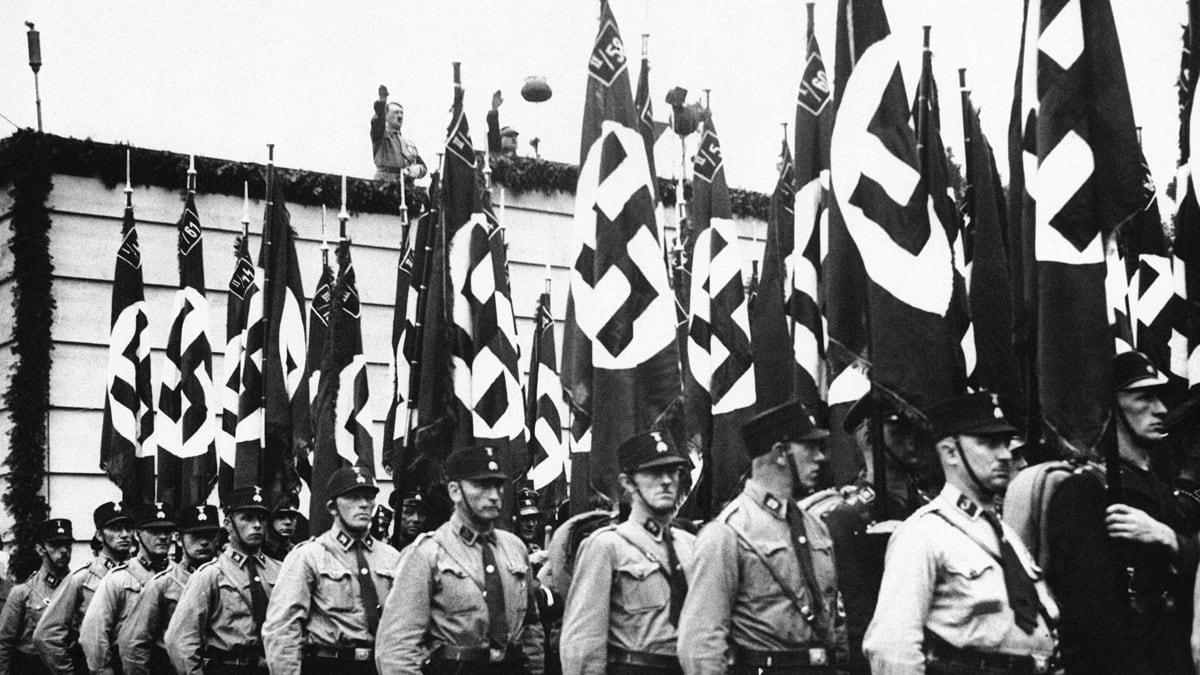
Observe the picture given below and answer the following questions:
  1. The swastika sign shown in the above picture belonged to which party?
  2. Who was the head of that party? Throw light on his personality.
Healthcare is still a major issue in India. What are the major reasons responsible for this?
Give main characteristics of the largest peninsular river.Or
Which river is known as ‘Dakshin Ganga’? State any twocharacteristics of it.