Question
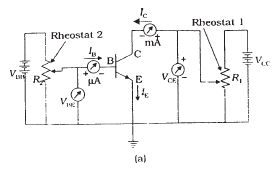
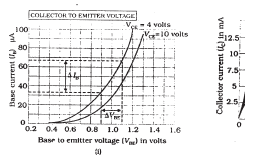
Explain the function of base region of a transistor. Why is this region made thin and lightly doped? Draw a circuit diagram to study the input and output characteristics of n-p-n transistor in a common emitter (CE) configuration. Show these characteristics graphically. Explain how current amplification factor of the transistor is calculated using output characteristics.
Answer

Its acts as interface between emitter and collector. or It controls/regulates the charge carriers moving from emitter to collector. To minimise base current or ensuring that most of current carriers, moving out of the emitter, move directly from emitter to collector.

Current amplification factor: This is defined as the ratio of the change in collector current (output current) to the change in base current. $\beta = \bigg(\frac{\bigtriangleup\text{I}_{c}}{\bigtriangleup\text{I}_{B}}\bigg)_{\text{V}_{cb}}$.

Need a full question paper?

Generate a complete, print-ready paper with questions like this in minutes — across 16+ boards, with answer keys.

Start Generating Free

Similar questions

A uniform rod of length L lies on a smooth horizontal table. A particle moving on the table strikes the rod perpendicularly at an end and stops. Find the distance travelled by the centre of the rod by the time it turns through a right angle. Show that if the mass of the rod is four times that of the particle, the collision is elastic.
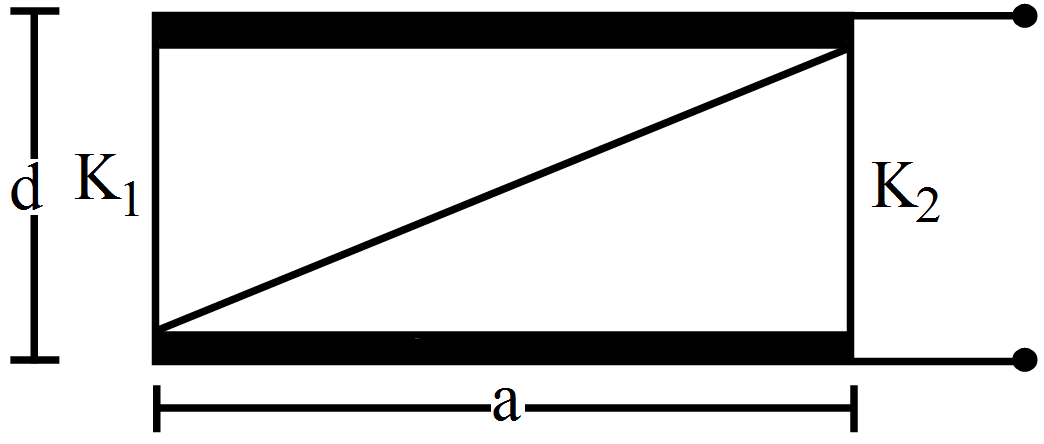
A capacitor is formed by two square metal-plates of edge a, separated by a distance d. Dielectrics of dielectric constants $K_1$ and $K_2$ are filled in the gap as shown in figure. Find the capacitance.
Derive an expression for the gravitational field due to a uniform rod of length L and mass M at a point on its perpendicular bisector at a distance d from the centre.
The amplifiers X, Y and Z are connected in series. If the voltage gains of X, Y and Z are 10, 20 and 30, respectively and the input signal is 1 mV peak value, then what is the output signal voltage (peak value):
  1. If dc supply voltage is 10V?
  2. If dc supply voltage is 5V?
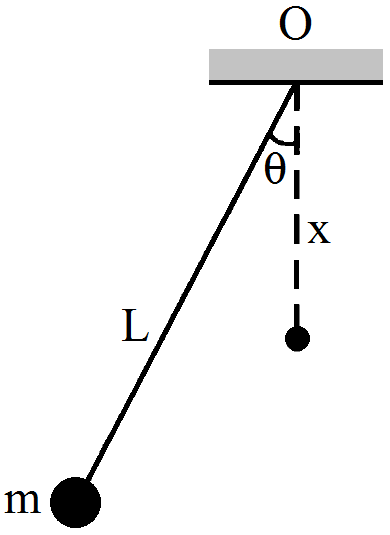
A simple pendulum of length L having a bob of mass m is deflected from its rest position by an angle $\theta$ and released (figure). The string hits a peg which is fixed at a distance x below the point of suspension and the bob starts going in a circle centred at the peg.
  1. Assuming that initially the bob has a height less than the peg, show that the maximum height reached by the bob equals its initial height.
  2. If the pendulum is released with $\theta=90^\circ$ and $\text{x}=\frac{\text{L}}{2}$ find the maximum height reached by the bob above its lowest position before the string becomes slack.
  3. Find the minimum value of $\frac{\text{x}}{\text{L}}$ for which the bob goes in a complete circle about the peg when the pendulum is released from $\theta=90^\circ.$
When a parallel beam of a monochromatic source of light of wavelength $\lambda$ is incident on a single slit of width a, show how the diffraction pattern is formed at the screen by the interference of the wavelets from the slit. Show that, besides the central maxima $\theta=0$, secondary maxima are observed at $\theta=\left(n+\frac{1}{2}\right) \frac{\lambda}{a}$ and the minima at $\theta=\frac{n \lambda}{a}$. Why do secondary maxima get weaker in intensity with increasing n?
The temperature and pressure at Simla are 15.0°C and 72.0cm of mercury and at Kalka these are 35.0°C and 76.0cm of mercury. Find the ratio of air density at Kalka to the air density at Simla.
Answer the following Questions.
  1. Find expressions for the force and torque on an electric dipole kept in a uniform electric field.
OR

An electric dipole is held in a uniform electric field. (i) Using suitable diagram show that it does not undergo any translatory motion, and (ii) derive an expression for torque acting on it and specify its direction.
  1. Derive an expression for the work done in rotating a dipole from the angle $\theta_0$ to $\theta_1$ in a uniform electric field E.
​​​​​​​OR
  1. Define torque acting on a dipole of dipole moment $\vec{\text{p}}$ placed in a uniform electric field $\vec{\text{E}}.$ Express it in the vector form and point out the direction along which it acts.
  2. What happens if the field is non-uniform?
  3. What would happen if the external field $\vec{\text{E}}$ is increasing (i) parallel to $\vec{\text{p}}$ and (ii) anti-parallel to $\vec{\text{p}}?$
The difference in the frequencies of series limit of Lyman series and Balmer series is equal to the frequency of the first line of the Lyman series. Explain.
A U-tube having unequal arm-lengths has water in it. A tuning fork of frequency 440Hz can set up the air in the shorter arm in its fundamental mode of vibration and the same tuning fork can set up the air in the longer arm in its first overtone vibration. Find the length of the air columns. Neglect any end effect and assume that the speed of sound in air = 330m/s.