Question Bank [2022] — BIOLOGY STD 12 Science — Question
Maharashtra BoardEnglish MediumSTD 12 ScienceBIOLOGYQuestion Bank [2022]3 Marks
Question
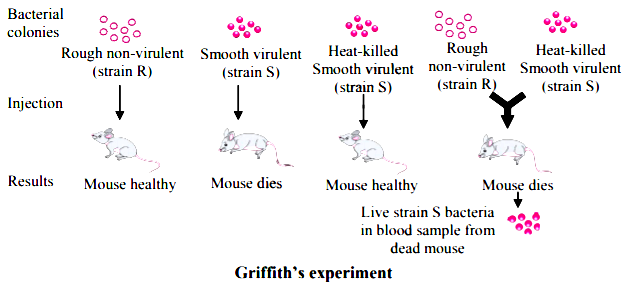
Explain the Griffith’s experiment in detail with diagram.
✓
Answer
In 1928, Frederick Griffith performed an experiment with Streptococcus pneumoniae (bacterium responsible for causing pneumonia).
There are two strains of the bacteria:
S-strain whose cells produce a capsule of polysaccharides (capsulated). This strain is virulent (pathogenic) and causes pneumonia.
R-strain whose cells lack a capsule (non-capsulated) and are avirulent or non-pathogenic.
Griffith performed his experiment by injecting the above strains of bacteria into mice and found the following results:
R-strain (non-virulent) bacteria were injected into mice, the mice suffered no illness because R-strain was non-pathogenic.
S-strain (virulent) bacteria were injected into mice, the mice developed pneumonia and finally died.
Then, Griffith injected heat-killed S-strain bacteria into mice and they survived.
A mixture of living R-strain and heat-killed S-strain were injected into mice, the mice developed pneumonia and died. Large numbers of live strain bacteria were recovered from the blood of the dead mice.
He concluded that some genetic factor (transforming principle) from heat-killed S-strain cells transformed live R-strain cells into live S-strain and produced the disease.
Thus, Griffith’s experiment helped to identify the transformation of genetic material.
Need a full question paper?
Generate a complete, print-ready paper with questions like this in minutes — across 16+ boards, with answer keys.