Question
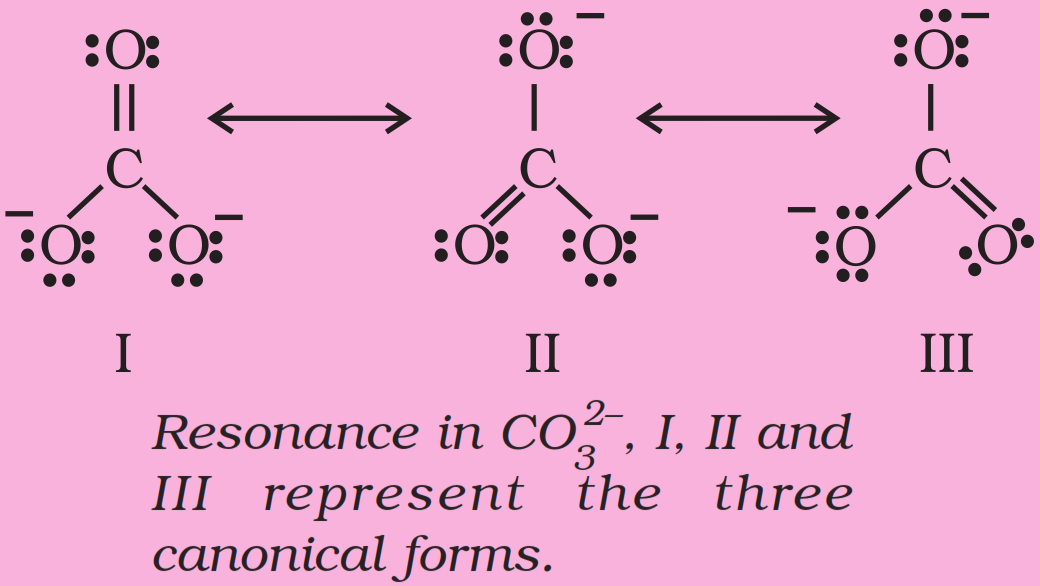
Explain the important aspects of resonance with reference to the $\text{CO}^{2-}_3$− ion.
Answer


Resonance in $\text{CO}_3^{2-}$, I, II and III represent the three canonical forms.

  • In these structures, the position of nuclei is same.
  • All the three forms have almost equal energy.
  • Same number of paired and impaired electrons, they differ only in their position.

Need a full question paper?

Generate a complete, print-ready paper with questions like this in minutes — across 16+ boards, with answer keys.

Start Generating Free

Similar questions

What is the pH of 0.001 M aniline solution? The ionisation constant of aniline is $4.27 \times 10^{-10}$. Calculate the degree of ionisation of aniline in the solution. Also calculate the ionisation constant of the conjugate acid of aniline.
  1. Show that the circumference of Bohr's orbit for the H-atom is an integral multiple of the de-Broglie wavelength of electron revolving around the orbit.
  2. Explain that the effect of the Heisenberg uncertainty principle is significant only for motion of microscopic objects and is negligible for that of macroscopic objects. [h = 6.626 × 10⁻³⁴Js, Mass of electron = 9.1 × 10⁻³¹kg].
  3. State Hund's Rule of maximum multiplicity.
  1. The reaction quotient of a reversible reaction is QC and the equilibrium constant is Kc. What do you conclude for the reaction if Qc < Kc?
  2. State Le Chatelier's principle.
  3. In qualitative analysis, NH4Cl is added before adding NH4OH solution for testing of III group radicals [Fe3+, Cr3+ and Al3+]. Explain by using concept of common ion effect.
The pH of milk, black coffee, tomato juice, lemon juice and egg white are 6.8, 5.0, 4.2, 2.2 and 7.8 respectively. Calculate corresponding hydrogen ion concentration in each.
Write correctly the balanced equations for the following redox reactions using half reactions.

  1. H2S+ Fe3+ → Fe2+ + S + H+ 
  2. I + $\text{IO}^-_3$ + H+ → I2 + H2
  3. Bi(s)+ $\text{NO}_3^-$ + H+ → NO2 + Bi3+ + H2O
  4. I- + O2(g) + H2O → I2 + OH-

State what is oxidised to what and what is reduced to what in the reactions expressed by the equations?

Write the effect of common ion effect on solubility of ionic salts.
  1. The equilibrium constant of a reaction is 2 × 10-3 at 25°C and 2 × 10-2 at 50°C Is the reaction endothermic or exothermic?
  2. The solubility of CaF2 in water at 298K is 1.7 × 10⁻³ gram per 100ml of the solution.

Calculate solubility product of CaF2.

What is Gibbs energy? How does this explain spontaneity?
  1. What is the total number of electrons in $\text{NO}^-_3$ and $\text{NH}^+_4?$
  2. Why is melting point of MgO (2800°C) higher than that of BaO (1920°C)?
  3. Why is solubility of MgCl, greater than that of MgF2?
  4. Why are carbon-oxygen bond lengths in Na2CO3 equal?
  5. Why is AlF3 high melting solid whereas SiF4 is a gas?
If the photon of the wavelength 150pm strikes an atom and one of tis inner bound electrons is ejected out with a velocity of 1.5 × 10⁷ms –1, calculate the energy with which it is bound to the nucleus.