Question
Explain the lanthanoid contraction.

Answer

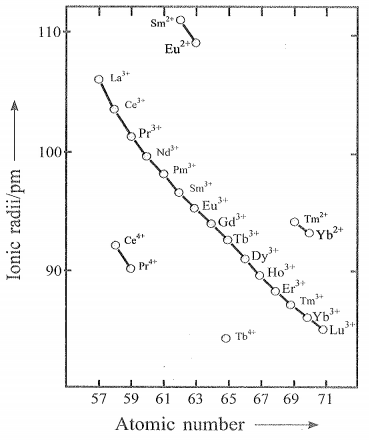
→ As we move along the lanthanoid series, the atomic number increases gradually by one. This means that the number of electrons and protons present in an atom also increases by one.
→ As electrons are being added to the same shell, the effective nuclear charge increases.
→ This happens because the increase in nuclear attraction due to the addition of proton is more pronounced than the increase in the interelectronic repulsions due to the addition of electron.
→ Also, with the increase in atomic number, the number of electrons in the 4f orbital also increases. The 4f electrons have poor shielding effect.
→ Therefore, the effective nuclear charge experienced by the outer electrons increases. Consequently, the attraction of the nucleus for the outermost electrons increases.
→ This results in a steady decrease in the size of lanthanoids with the increase in the atomic number. This is termed as lanthanoid contraction.
Image
→ Consequences of lanthanoid contraction
→ There is similarity in the properties of second and third transition series.
→ Separation of lanthanoids is possible due to lanthanoid contraction.
→ It is due to lanthanoid contraction that there is variation in the basic strength of lanthanoid hydroxides. (Basic strength decreases from La(OH)3 to Lu(OH)3.)

Need a full question paper?

Generate a complete, print-ready paper with questions like this in minutes — across 16+ boards, with answer keys.

Start Generating Free

Similar questions

Write down the IUPAC name for the following complex and indicate the oxidation state, electronic configuration and coordination number. Also give stereochemistry and magnetic moment of the complex:
K4[Mn(CN)6]
Lanthanum, gadolinium and lutetium are extraordinarily stable in +3 oxidation state. Explain.
(Atomic number: La = 57, Gd = 64, Lu = 71)
Write IUPAC names of the following coordination compounds:
  1. [Co(NH3)6]Cl3
  2. [Co(NH3)5Cl]Cl2
  3. K3[Fe(CN)6]
Account for any two of the following:
  1. Amines are basic substances while amides are neutral.
  2. Nitro compounds have higher boiling points than the hydrocarbons having almost the same molecular mass.
  3. Aromatic amines are weaker bases than aliphatic amines.
When a current of 0.75A is passed through a CuSO4 solution for 25 min, 0.369g of copper is deposited at the cathode. Calculate the atomic mass of copper.
Answer thefollowing:
  1. Haloalkanes easily dissolve in organic solvents,why?
  2. What is known as a racemic mixture? Give an example.
  3. Of the two bromoderivatives, C6H5CH(CH3)Br and C6H5CH(C6H5) Br, which one ismore reactive in SN1 substitution reaction and why?
Write the products formed when CH3CHO reacts with the following reagents:
  1. HCN.
  2. H2N—OH.
  3. CH3CHO in the presence of dilute NaOH.
Predict the order of reactivity of the four isomeric bromobutanes in SN1 and SN2 reactions.
How would you account for the following?
  1. The atomic radii of the metals of the third (5d) series of transition elements are virtually the same as those of the corresponding members of the second (4d) series.
  2. The Eo value for the Mn3+/Mn2+ couple is much more positive than that for Cr3+/Cr2+ couple or Fe3+/Fe2+ couple.
  3. The highest oxidation state of a metal is exhibited in its oxide or fluoride.