→ As we move along the lanthanoid series, the atomic number increases gradually by one. This means that the number of electrons and protons present in an atom also increases by one.
→ As electrons are being added to the same shell, the effective nuclear charge increases.
→ This happens because the increase in nuclear attraction due to the addition of proton is more pronounced than the increase in the interelectronic repulsions due to the addition of electron.
→ Also, with the increase in atomic number, the number of electrons in the 4f orbital also increases. The 4f electrons have poor shielding effect.
→ Therefore, the effective nuclear charge experienced by the outer electrons increases. Consequently, the attraction of the nucleus for the outermost electrons increases.
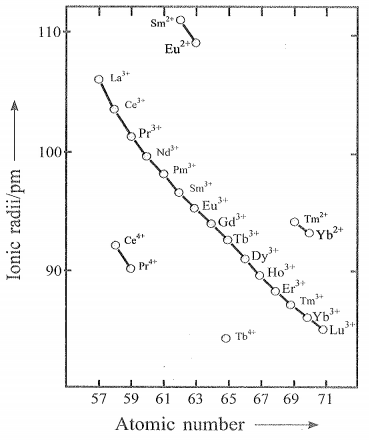
→ This results in a steady decrease in the size of lanthanoids with the increase in the atomic number. This is termed as lanthanoid contraction.
→ Consequences of lanthanoid contraction
→ There is similarity in the properties of second and third transition series.
→ Separation of lanthanoids is possible due to lanthanoid contraction.
→ It is due to lanthanoid contraction that there is variation in the basic strength of lanthanoid hydroxides. (Basic strength decreases from La(OH)
3 to Lu(OH)
3.)