Question
Explain the law of dominance by Punnet Square method.
Answer

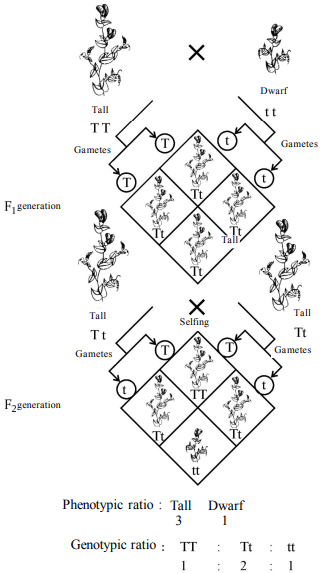
The Punnett Square shows the parental tall TT (male) and dwarf tt (female) plants, the gametes produced by them and, the $F _1 T t$ progeny. The $F _1$ plants of genotype Tt are self-pollinated. The symbols and are used to denote the female (eggs) and male (pollen) of the $F _1$ generation, respectively. The $F_1$ plant of the genotype $T t$ when self-pollinated, produces gametes of the genotype $T$ and $t$ in equal proportion. When fertilisation takes place, the pollen grains of genotype $T$ have a 50 per cent chance to pollinate eggs of the genotype T, as well as of genotype $t$. Also pollen grains of genotype $t$ have a 50 per cent chance. A Punnett square used to understand a typical monohybrid cross conducted by Mendel between true-breeding tall plants and true-breeding dwarf plants of pollinating eggs of genotype $T$, as well as of genotype $t$. As a result of random fertilisation, the resultant zygotes can be of the genotypes TT, Tt or $t t$.
From the Punnett square it is easily seen that $1 / 4$ th of the random fertilisations lead to TT, $1 / 2$ lead to $T t$ and $1 / 4$ th to $t t$. Though the $F _1$ have a genotype of $T t$, but the phenotypic character seen is 'tall'. At $F _2, 3 / 4$ th of the plants are tall, where some of them are TT while others are Tt. Externally it is not possible to distinguish between the plants with the genotypes TT and Tt. Hence, within the genopytic pair Tt only one character ' $T$ ' tall is expressed. Hence the character $T$ or 'tall' is said to dominate over the other allele $t$ or 'dwarf character. It is thus due to this dominance of one character over the other that all the $F _1$ are tall (though the genotype is Tt) and in the F2 3/4th of the plants are tall (though genotypically $1 / 2$ are Tt and only $1 / 4$ th are TT). This leads to a phenotypic ratio of 3/4th tall : (1/4 TT + 1/2 Tt) and 1/4th $t t$, i.e., a $3: 1$ ratio, but a genotypic ratio of $1: 2: 1$.
Image

Need a full question paper?

Generate a complete, print-ready paper with questions like this in minutes — across 16+ boards, with answer keys.

Start Generating Free

Similar questions

In a pond, we see plants which are free-floating; rooted–submerged; rooted emergent; rooted with floating leaves. Write the type of plants against each of them.
 
Plant Name
Type
a.
Hydrilla
____________
b.
Typha
____________
c.
Nymphaea
____________
d.
Lemna
____________
e.
Vallisnaria
____________
Write the important characteristic of cromagnon man and also clarify that it was closest ancestor of modern man?
The following is the illustration of the sequence of ovarian events (a – i) in a human female.
What is the difference between “d” and “e” ?
(i) Define the pollination.
(ii) Explain the process of double fertilization.
(iii) Draw a well labelled diagram of fertilized
embryo sac.
Which methodology is used while sequencing the total DNA from a cell? Explain it in detail.
DNA separated from one cell, when introduced in another cell, is able to bestow some of the properties of the former to the latter. What is this change called in technical terms? Describe the experiment evidences which led to the discovery of the above phenomenon.
What is ecosystem? Mention its biotic components. Draw a diagram of four trophic levels food chain for a grassland ecosystem.
(i) Define contact inhibition.
(ii) Explain the difference between benign tumors
and malignant tumors.
(iii) Write any one cause of cancer.
  1. A true breeding pea plant, homozygous for inflated green pods is crossed with another pea plant with constricted yellow pods (ffgg). What would be the phenotype and genotype of $F_1$ and $F_2$ generations? Give the phenotype ratio of generation.
  2. State the generalisation proposed by Mendel on the basis of the above–Mentioned cross.
Naman entered into a quarrel with some farmers who were spraying DDT in their field. Many people gathered at the spot to see and enjoy the incident. The angry mob demanded that Naman should not interfere in the farmer's job. Naman tried to explain his point and finally succeeded in explaining the harmful effects of DDT.
  1. What is biomagnification? Explain with an example.
  2. Is biomagnification related with DDT only? Comment.
  3. What is the effect of DDT on birds?
  4. What values did Naman promote?
