Question
Explain the law of dominance by Punnet Square method.
Answer

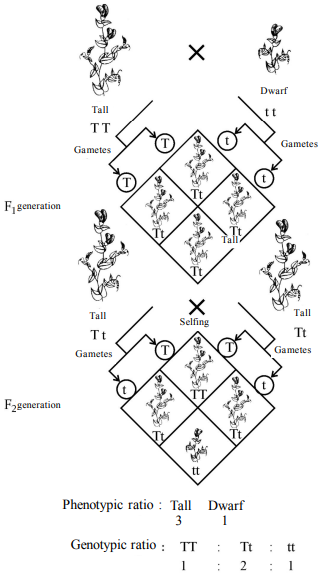
The Punnett Square shows the parental tall TT (male) and dwarf tt (female) plants, the gametes produced by them and, the $F _1 T t$ progeny. The $F _1$ plants of genotype Tt are self-pollinated. The symbols and are used to denote the female (eggs) and male (pollen) of the $F _1$ generation, respectively. The $F_1$ plant of the genotype $T t$ when self-pollinated, produces gametes of the genotype $T$ and $t$ in equal proportion. When fertilisation takes place, the pollen grains of genotype $T$ have a 50 per cent chance to pollinate eggs of the genotype T, as well as of genotype $t$. Also pollen grains of genotype $t$ have a 50 per cent chance. A Punnett square used to understand a typical monohybrid cross conducted by Mendel between true-breeding tall plants and true-breeding dwarf plants of pollinating eggs of genotype $T$, as well as of genotype $t$. As a result of random fertilisation, the resultant zygotes can be of the genotypes TT, Tt or $t t$.
From the Punnett square it is easily seen that $1 / 4$ th of the random fertilisations lead to TT, $1 / 2$ lead to $T t$ and $1 / 4$ th to $t t$. Though the $F _1$ have a genotype of $T t$, but the phenotypic character seen is 'tall'. At $F _2, 3 / 4$ th of the plants are tall, where some of them are TT while others are Tt. Externally it is not possible to distinguish between the plants with the genotypes TT and Tt. Hence, within the genopytic pair Tt only one character ' $T$ ' tall is expressed. Hence the character $T$ or 'tall' is said to dominate over the other allele $t$ or 'dwarf character. It is thus due to this dominance of one character over the other that all the $F _1$ are tall (though the genotype is Tt) and in the F2 3/4th of the plants are tall (though genotypically $1 / 2$ are Tt and only $1 / 4$ th are TT). This leads to a phenotypic ratio of 3/4th tall : (1/4 TT + 1/2 Tt) and 1/4th $t t$, i.e., a $3: 1$ ratio, but a genotypic ratio of $1: 2: 1$.
Image

Need a full question paper?

Generate a complete, print-ready paper with questions like this in minutes — across 16+ boards, with answer keys.
Start Generating Free

Similar questions

Read the following and answer any four questions from (i) to (v) given below:

Gene therapy is the technique of genetic engineering to replace a faulty gene by a normal healthy functional gene. It is a way of treating genetic disease by introducing a piece of DNA into the cells of an affected individual. Liposomes can be used for gene therapy as they target the cells affected by a genetic disease.

  1. A patient suffers from adenosine deaminase (ADA) deficiency, an autosomal recessive immune deficiency in which bone marrow lymphoblasts cannot replicate to generate immuno-competent lymphocytes. The treatment option that would cure the patient is:
  1. Germ-line gene therapy to replace one ADA gene copy.
  2. Germ-line gene therapy to replace both ADA gene copies.
  3. Somatic cell gene therapy to replace both ADA gene copies in circulating lymphocytes.
  4. Somatic cell gene therapy to replace one ADA gene copy in bone marrow lymphoblasts.
  1. Which type of gene therapy is least effective in transferring DNA to the nucleus?
  1. Adenoviruses.
  2. DNA attached to a ligand.
  3. Liposomes.
  4. Retroviruses.
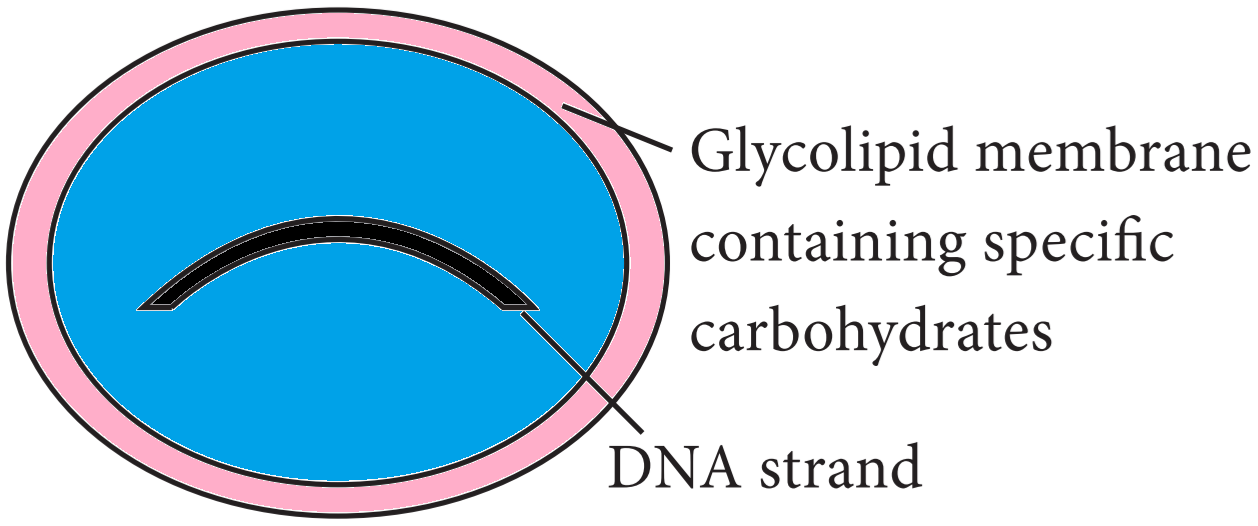
  1. Liposomes can be used for gene therapy as they target the cells affected by a genetic disease. The diagram shows the structure of a liposome.

What feature of a cell surface membrane allows the liposome to target cells affected by a genetic disease? 

  1. Carrier molecules.
  2. Phosphate groups.
  3. Protein channels.
  4. Receptor molecules.
  1. Which of the following disorders would gene therapy be least effective?
  1. Cystic fibrosis.
  2. Huntington's disease.
  3. Sickle cell anaemia.
  4. Type II diabetes.
  1. Following are some reasons explaining why gene therapy is not yet fully an effective treatment for genetic diseases.
  1. Lack of knowledge of DNA sequences.
  2. Lack of efficient and safe gene delivery system.
  3. Cost of the technology.
  4. Some diseases involve multiple genes.
  5. Problems with appropriate gene regulation.

Select the correct option. 

  1. I, III and V only
  2. II, IV and V only
  3. Ill, IV and V only
  4. I, III and IV only
What are recombinant DNA vaccines? Give two examples of such vaccines. Discuss their advantages.
Draw and explain a logistic curve for a population of density (N) at time (t) whose intrinsic rate of natural increase is (r) and carrying capacity is (k).
Taking examples under each category, discuss upstream and downstream processing.
Draw a diagram and briefly describe the life cycle of Plasmodium.###Make a labeled diagram and briefly describe the various stages of the life cycle of Plasmodium.
Define transcription. Write the names of the parts of the transcription unit in DNA. Draw a schematic diagram of the transcription unit.
What are the major features of embryonic development at various months of pregnancy?
In your view what motivates youngsters to take to alcohol or drugs and how can this be avoided?
Describe biological evolution from paleontological and embryological evidences.
Describe the beneficial activities of bacteria. ###How can we say that bacteria are our friends? Explain.