Principles of Inheritance and Variation — BIOLOGY STD 12 Science — Question
Bihar BoardEnglish MediumSTD 12 ScienceBIOLOGYPrinciples of Inheritance and Variation5 Marks
Question
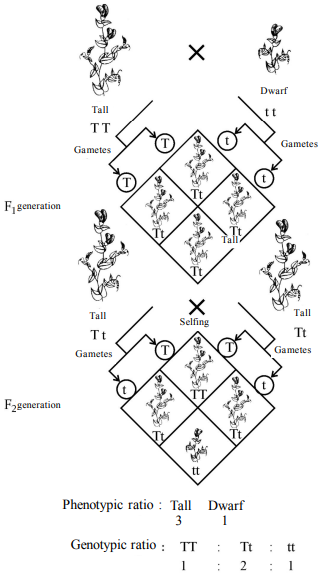
Explain the law of dominance by Punnet Square method.
✓
Answer
The Punnett Square shows the parental tall TT (male) and dwarf tt (female) plants, the gametes produced by them and, the $F _1 T t$ progeny. The $F _1$ plants of genotype Tt are self-pollinated. The symbols and are used to denote the female (eggs) and male (pollen) of the $F _1$ generation, respectively. The $F_1$ plant of the genotype $T t$ when self-pollinated, produces gametes of the genotype $T$ and $t$ in equal proportion. When fertilisation takes place, the pollen grains of genotype $T$ have a 50 per cent chance to pollinate eggs of the genotype T, as well as of genotype $t$. Also pollen grains of genotype $t$ have a 50 per cent chance. A Punnett square used to understand a typical monohybrid cross conducted by Mendel between true-breeding tall plants and true-breeding dwarf plants of pollinating eggs of genotype $T$, as well as of genotype $t$. As a result of random fertilisation, the resultant zygotes can be of the genotypes TT, Tt or $t t$. From the Punnett square it is easily seen that $1 / 4$ th of the random fertilisations lead to TT, $1 / 2$ lead to $T t$ and $1 / 4$ th to $t t$. Though the $F _1$ have a genotype of $T t$, but the phenotypic character seen is 'tall'. At $F _2, 3 / 4$ th of the plants are tall, where some of them are TT while others are Tt. Externally it is not possible to distinguish between the plants with the genotypes TT and Tt. Hence, within the genopytic pair Tt only one character ' $T$ ' tall is expressed. Hence the character $T$ or 'tall' is said to dominate over the other allele $t$ or 'dwarf character. It is thus due to this dominance of one character over the other that all the $F _1$ are tall (though the genotype is Tt) and in the F2 3/4th of the plants are tall (though genotypically $1 / 2$ are Tt and only $1 / 4$ th are TT). This leads to a phenotypic ratio of 3/4th tall : (1/4 TT + 1/2 Tt) and 1/4th $t t$, i.e., a $3: 1$ ratio, but a genotypic ratio of $1: 2: 1$.
Need a full question paper?
Generate a complete, print-ready paper with questions like this in minutes — across 16+ boards, with answer keys.