Question
Explain the laws of transverse vibrations.

Answer

SELF

Need a full question paper?

Generate a complete, print-ready paper with questions like this in minutes — across 16+ boards, with answer keys.
Start Generating Free

Similar questions

For the wave described in Exercise 15.8, plot the displacement (y) versus (t) graphs for x = 0, 2 and 4cm. What are the shapes of these graphs? In which aspects does the oscillatory motion in travelling wave differ from one point to another: amplitude, frequency or phase?
A beam of white light is incident normally on a plane surface absorbing 70% of the light and reflecting the rest. If the incident beam carries 10W of power, find the force exerted by it on the surface.
A hill is $500m$ high. Supplies are to be sent across the hill using a canon that can hurl packets at a speed of $125m/ s$ over the hill. The canon is located at a distance of $800m$ from the foot of hill and can be moved on the ground at a speed of $2m/ s$; so that its distance from the hill can be adjusted. What is the shortest time in which a packet can reach on the ground across the hill? Take $g =10m/ s^2$.
A body of mass $0.40kg$ moving initially with a constant speed of $10ms^{-1}$ to the north is subject to a constant force of $8.0 N$ directed towards the south for $30s$. Take the instant the force is applied to be $t = 0$, the position of the body at that time to be $x = 0$, and predict its position at $t = –5s, 25s, 100s$.
Explain isothermal, isobaric and adiabatic processes and write equations of state for them.
A cricketer can throw a ball to a maximum horizontal distance of 100m. How much high above the ground can the cricketer throw the same ball?
  1. What is beat phenomenon?
  2.  


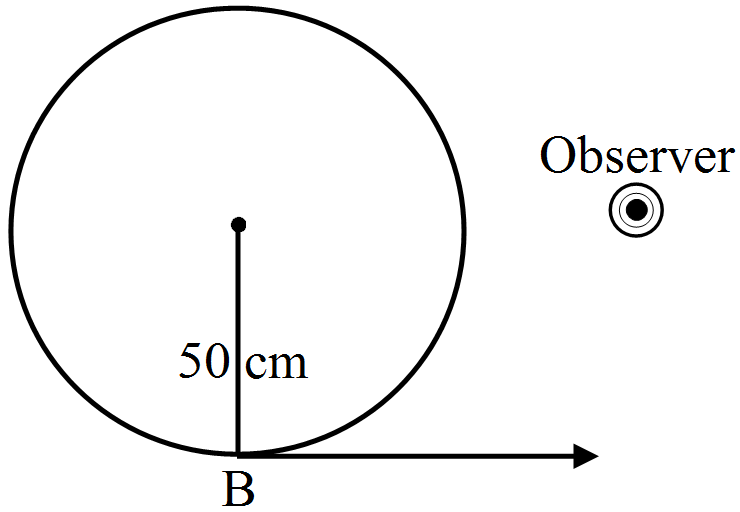
A whistle revolve in a circle with angular velocity of o =$20 rad s^{-1}$. If the frequency of the sound is $385Hz$ and speed is $340ms^{-1}$, than find the frequency heard by the observer when the whistle is at B.
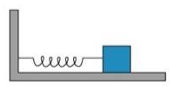
A spring having with a spring constant $1200 N m ^{-1}$ is mounted on a horizontal table as shown in Fig. A mass of 3 kg is attached to the free end of the spring. The mass is then pulled sideways to a distance of 2.0 cm and released.
Image

Take the position of mass when the spring is unstreched as $x=0$, and the direction from left to right as the positive direction of $x$-axis. Give $x$ as a function of time $t$ for the oscillating mass if at the moment we start the stopwatch $(t=0)$, the mass is
a. at the mean position,
b. at the maximum stretched position, and
c. at the maximum compressed position.
In what way do these functions for SHM differ from each other, in frequency, in amplitude or the initial phase?
Jupiter has a mass 318 times that of the earth, and its radius is 11.2 times the earth's radius. Estimate the escape velocity of a body from Jupiter's surface given that the escape velocity from the earth's surface is $11.2km s^{-1}$.
Two current-carrying wires may attract each other. In absence of other forces, the wires will move towards each other increasing the kinetic energy. Does it contradict the fact that the magnetic force cannot do any work and hence cannot increase the kinetic energy?