Question
Explain the mechanism of compost formation.

Answer

Mechanism of compost formation:
  1. A trench of dimension of 4 to 5m long, 1.5 to 1.8m broad and 1.0 to 1.8m deep is dug.
  2. A layer of well mixed refuse of about 30cm thickness is spread in the trench.
  3. The refuse layer is well moistened by slurry of cow dung, earth and water.
  4. Now, a second layer of well mixed refuse is spread in trench till the heap rises to a height of 45 to 60cm above the ground level.
  5. The top of the heap is covered with a thin layer of moist earth.
  6. After three months, the material is taken out of the trench and placed in the form of conical heap. The conical heap, if required, be suitably moistened and should be covered with earth.
  7. Conical heap is left undisturbed for about one to two months. After this period, compost can be used in crop fields.

Need a full question paper?

Generate a complete, print-ready paper with questions like this in minutes — across 16+ boards, with answer keys.

Start Generating Free

Similar questions

An electron moving with a velocity of 5 × 10⁴ m s-1 enters into a uniform electric field and acquires a uniform acceleration of 104 m s–2 in the direction of its initial motion. Calculate the time in which the electron would acquire a velocity double of its initial velocity. How much distance the electron would cover in this time?
Raunak took $5$ moles of carbon atoms in a container and Krish also took $5$ moles of sodium atoms in another container of same weight.
  1. Whose container is heavier?
  2. Whose container has more number of atoms?
Two objects having equal masses are moving with uniform velocities of $2m/s$ and $6m/s$ respectively. Calculate the ratio of their kinetic energies.
Explain giving reasons: Social harmony and good economic conditions are necessary for good health.
A stone is dropped from a height of $20m.$
How long will it take to reach the ground$?$

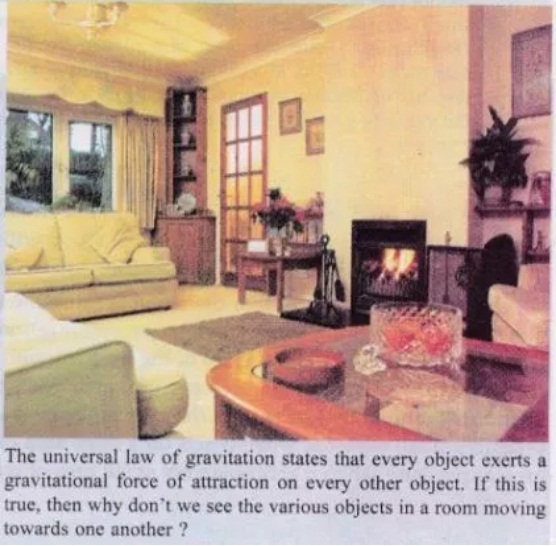
Universal law of gravitation states that every object exerts a gravitational force of attraction on every other object. If this is true, why don’t we notice such forces? Why don’t the two objects in a room move towards each other due to this force?
The distance between Delhi and Agra is 200km. A train travels the first 100km at a speed of 50km/h. How fast must the train travel the next 100km, so as to average 70km/h for the whole journey?
Define acceleration due to gravity. Derive an expression for acceleration due to gravity in terms of mass of the earth (M) and universal gravitational constant (G).
Obtain a relation for the distance travelled by an object moving with a uniform acceleration in the interval between 4th and 5th seconds.
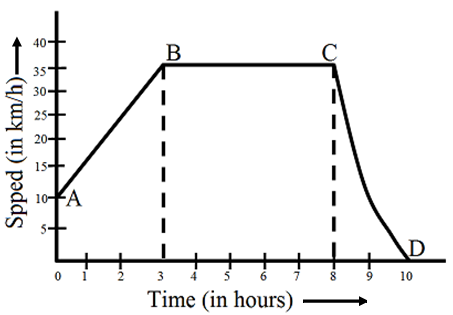
The graph given alongside shows how the speed of a car changes with time:


  1. What is the initial speed of the car?
  2. What is the maximum speed attained by the car?
  3. Which part of the graph shows zero acceleration
  4. Which part of the graph shows varying retardation?
  5. Find the distance travelled in first 8 hours.