Bihar BoardEnglish MediumSTD 12 ScienceBIOLOGYMolecular basis of Inheritance2 Marks
Question
Explain the meselson stahle experiment.
✓
Answer
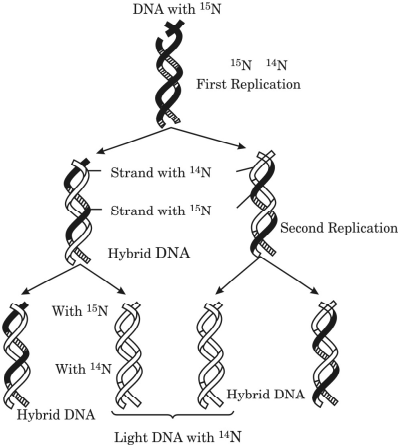
Messelson and Stahl (1958) grew the bacterium Escherichia coli in a medium containing nitrogen salts with stable isotope ${ }^{15} N$. ${ }^{15} N$ got incorporated into both strands of DNA and this DNA was heavier as compared to the DNA obtained from E. coli grown in ${ }^{14} N$ medium. The heavier DNA could be separated by centrifugation. Messelson and Stahl obtained E. coli cells grown in ${ }^{15} N$ and transferred them to a medium containing ${ }^{14} N$. After one generation, when bacterial cell had multiplied into two, they isolated the DNA and evaluated its density which was found to be intermediate between that of the heavier ${ }^{15} N$ DNA and lighter ${ }^{14} N$ DNA. Clearly, this was because during one generation, new DNA molecules with ${ }^{15} N$ old strand and a complementary ${ }^{14} N$ new strand were formed (having intermediate density). It proved that DNA replication is semiconservative.
Need a full question paper?
Generate a complete, print-ready paper with questions like this in minutes — across 16+ boards, with answer keys.