Question
Explain the morphology of an earthworm.

Answer

Morphology of Earthworm:

Body: Earthworms have long cylindrical body. The body is divided into more than hundred short segments which are similar (metameres about 100-120 in number).

Dorsal Surface: The dorsal surface of the body is marked by a dark median mid dorsal line (dorsal blood vessel) along the longitudinal axis of the body.

Ventral Surface: The ventral surface is distinguished by the presence of genital openings (pores).
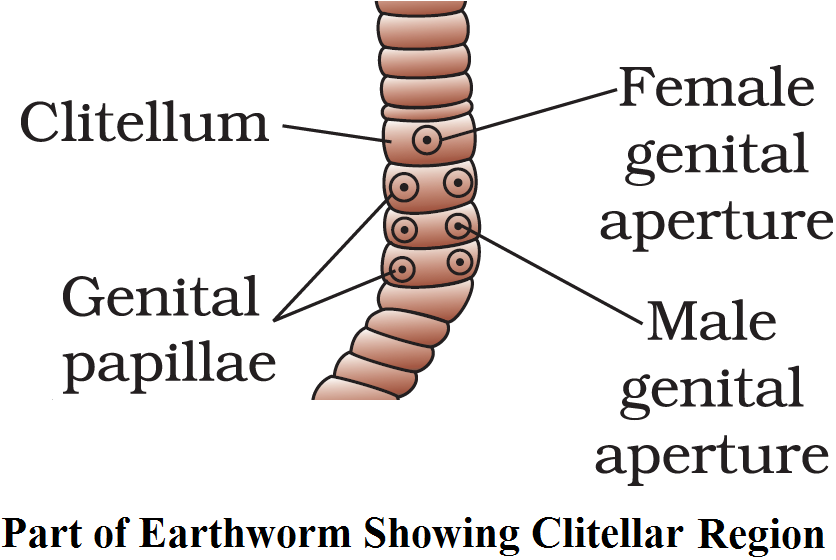
Segments: In a mature worm, segments 14-16 are covered by a prominent dark band of glandular tissue called clitellum. Thus the body is divisible into three prominent regions.

  • Preclitellar.
  • Clitellar.
  • Costclitellar segments.
Buccal Region: Anterior end consists of the mouth and the prostomium, a lobe which serves as a covering for the mouth and as a wedge to force open cracks in the soil into which the earthworm may crawl. The prostomium is sensory in function. The first body segment is called the peristomium (buccal segment) which contains the mouth.

Genital Openings: Four pairs of spermathecal apertures are situated on the ventro-lateral sides of the intersegmental grooves, i.e., 5th-9th segments. A single female genital pore is present in the mid-ventral line of 14th segment. A pair of male genital pores are present on the ventro-lateral sides of the 18th segment.

Locomotion: In each body segment, except the first, last and clitellum, there are rows of S-shaped setae, embedded in the epidermal pits in the middle of each segment. Setae can be extended or retracted. Their principal role is in locomotion.

Need a full question paper?

Generate a complete, print-ready paper with questions like this in minutes — across 16+ boards, with answer keys.

Start Generating Free