The body of cockroach is compressed dorso – ventrally, bilaterally symmetrical and segmented. The body is divisible into head, thorax and abdomen. The entire body is covered by a hard, brown, chitinous exoskeleton. In each segment.
exoskeleton has hardened plates called scierites which are joined by a delicate and elastic articular membrane or arthrodial membrane. The sclerites on the dorsal side are called tergites, and those on the ventral side are called stemites and those on the lateral sides are called pleurites.
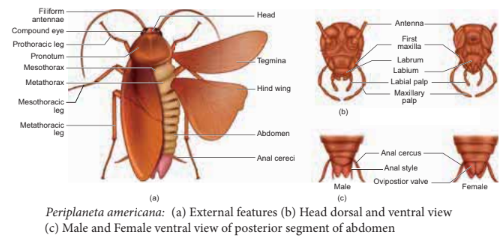
Head :
Head is small, triangular lies at right angle to the longitudinal axis. The mouth parts are directed downwards so it is hypognathous. The head has a pair of large, sessile and reniform compound eyes, a pair of antennae and appendages around the mouth part.
Antennae have sensory organs. The cockroach has a biting and chewing type (mandibulate or orthopterus type) of mouth parts. It includes a labrum, a pair of mandibles, a pair of maxillae, a labium and a hypopharynx or lingua.
Thorax :
The thorax consists of three segments, prothorax, mesothorax and metathorax. The head is connected with thorax by a short neck or cervicum. Each thoracic segment has three pairs of walking legs. Each leg consists of five segments, coxa, trochanter, femur, tibia and tarsus.
The tarsus has five movable joints or podomeres or tarsomeres. A pair of forewings arises from the mesothorax called elytra or tegmina. It protects the hind wings when at rest. The second pair membranous wings arises from the metathorax and are used in flight.