Question
Explain the nature of Accounting Standards.

Answer

Following points highlight the nature of Accounting Standards:
  1. Accounting Standards are guidelines providing the framework so that credible Financial Statements are prepared.
  2. The objective of setting Accounting Standards is to bring uniformity in accounting practices and to ensure transparency, consistency and comparability.
  3. Accounting Standards are prepared keeping in view the business environment and laws of the country. It, therefore, naturally means that the guidelines change with change in business environment and laws. It is because of this that Accounting Standards are being revised from time to time. It may be noted that whenever a conflict arises between law and Accounting Standards, law will prevail.
  4. Accounting Standards are mandatory in nature.
  5. Accounting Standards have also been made flexible in the sense that where alternative accounting practices are acceptable, an enterprise may adopt any of the practices with a suitable disclosure. For example, an enterprise may charge depreciation on the Written Down Value Method or Straight Line Method.

Need a full question paper?

Generate a complete, print-ready paper with questions like this in minutes — across 16+ boards, with answer keys.

Start Generating Free

Similar questions

On 1st April, 2015, furniture costing ₹ 55,000 was purchased. It is estimated that its life is 10 years at the end of which it will be sold for ₹ 5,000. Additions are made on 1st April 2016 and 1st October, 2018 to the value of ₹ 9,500 and ₹ 8,400 (Residual values ₹ 500 and ₹ 400 respectively). Show the Furniture Account for the first four years, if Depreciation is written off according to the Straight Line Method.
What is cash book? Explain the types of cash book.
What is Capital Expenditure? Give six examples of Capital Expenditure.
Compile a Two Column Cash Book from the following transactions of Kavita Garments:
2017
 
Feb. 1
Cash in hand ₹ 7,500; Cash at bank ₹ 8,000
Feb. 3
Received a cheque of ₹ 5,880 for cash sales. Cheque was immediately deposited into bank
Feb. 5
Received two cheques from Kalpna each of ₹ 10,000
Feb. 6
First cheque received from Kalpna is endorsed to Sunita in full settlement of ₹ 10,200
Second cheque is sent to bank for collection
Feb. 8
Second cheque received from Kalpna is returned as dishonoured by the bank
The bank has debited our account with ₹ 20 as bank charges on this cheque
Feb. 10
Received cheque from sale of old furniture ₹ 1,950. Next day, the cheque is endorsed to a creditor Ramesh in full settlement of ₹ 2,000 due to him
Feb. 12
Purchased goods from Mohan on Credit for ₹ 8,000
Feb. 15
Settled Mohan's account by giving a cheque for ₹ 4,000 and Cash ₹ 3,900
Feb. 16
Goods sold to Pawan for ₹ 6,000. He paid the amount in cash immediately after deducting $2\frac{1}{2}\%$ cash discount
Feb. 20
Paid salary by cheque ₹ 5,000
Feb. 25
Cash sale to date ₹ 50,000 of which ₹ 40,000 banked
Feb. 26
Paid electric bill of ₹ 2,000 for January by cheque. Paid Rent for January ₹ 1,500
Feb. 27
Cash purchases ₹ 5,000, issued a cheque
Feb. 28
Deposited into bank cash retaining ₹ 7,500
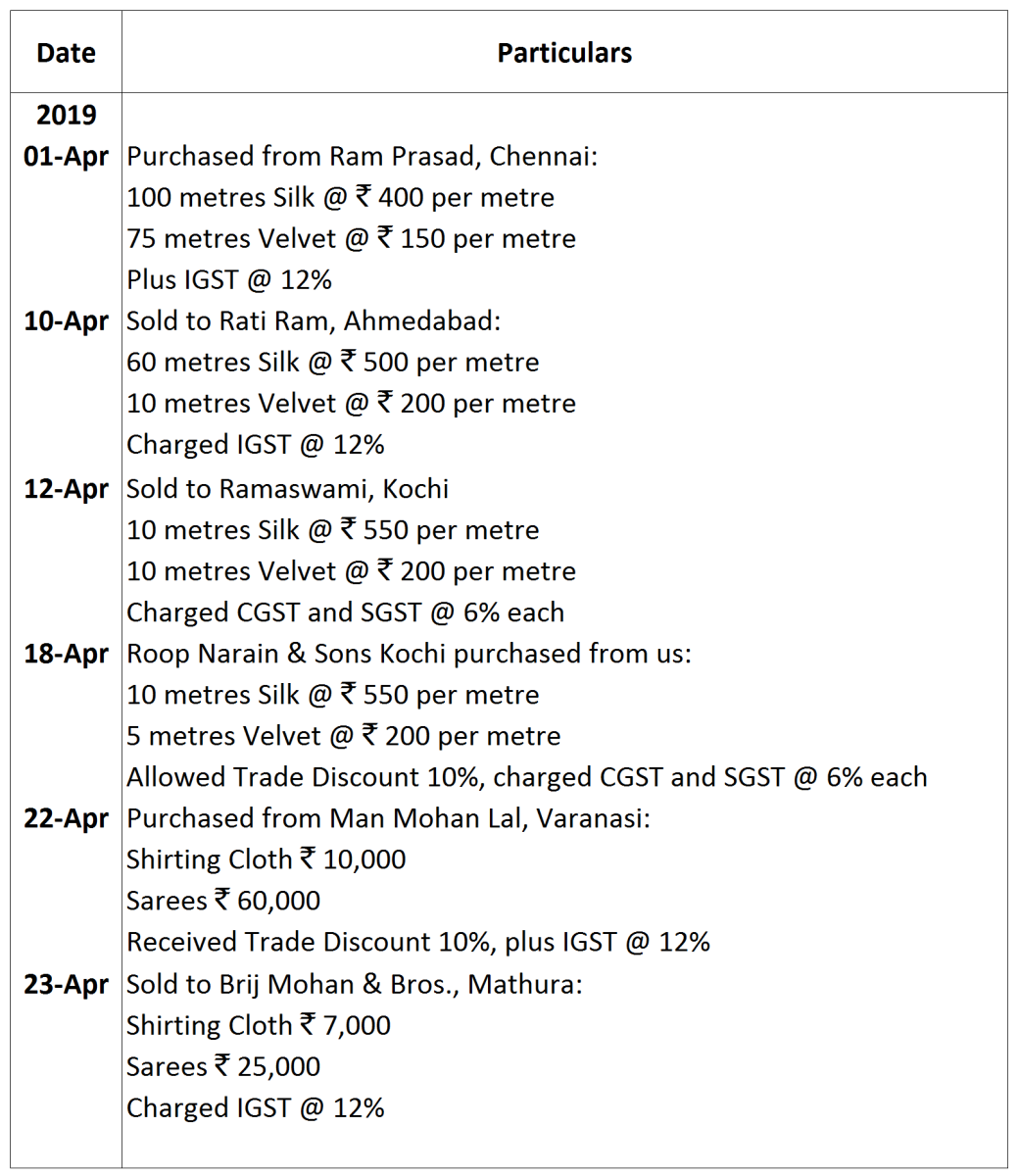
Write up Purchases and Sales Books from the following transactions of Kalyan Silks, Kochi, Kerala given for April, 2019 and post the totals in the Ledger.
Rectify the following errors and ascertain the amount of difference in trial balance by preparing suspense account:
  1. Credit sales to Mohan ₹ 7,000 were posted as ₹ 9,000.
  2. Credit purchases from Rohan ₹ 9,000 were posted as ₹ 6,000.
  3. Goods returned to Rakesh ₹ 4,000 were posted as Rs. 5,000.
  4. Goods returned from Mahesh ₹ 1,000 were posted as ₹ 3,000.
  5. Cash sales ₹. 2,000 were posted as ₹ 200.
Prepare the Accounting Vouchers for the following transactions:?
2019
Particular
Jan-1
Started business with cash
2,00,000
Jan-1
Purchased furniture vide Cash Memo No. 210*
10,000
Jan-5
Opened a Bank Account in Canara Bank
60,000
Jan-10
Purchased garments on credit from M/s Madras Store vide Bill No. 291*
20,000
Jan-12
Sold shirts to Ram Parkash on credit vide Bill No. 1*
5,000
Jan-15
Sold shirts for cash vide Cash Memo No. 1*
7,000
Jan-20
Withdrew from bank for office use by cheque No. 23301
20,000
Jan-27
Withdrew for personal use by cheque No. 51003
5,000
Transactions marked with * are subject to levy of CGST and SGST @ 6% each.
Write a note on types of assets with one example of each.
On 15th January 2018, X sold goods to Y for ₹ 50,000 charging IGST @ 12%. Yimmediately paid ₹ 6,000 in cash and accepted two bills of equal amount, the first for one month and the second for two months. The first bill was met on due date but on the due date of the second bill, Y requested that the bill be renewed for a further period of two months. X agreed provided that interest at 15% p.a. was paid immediately in cash. Yagreed to this. The second bill was met on the due date.
Give journal entries in the books of X and Y.
Record journal entries for the following transactions in the books of Anudeep of Delhi:
  1. Bought goods ₹ 2,00,000 from Kanta of Delhi (CGST @ 9%, SGST @ 9%)
  2. Bought goods ₹ 1,00,000 for cash from Rajasthan (IGST @ 12%)
  3. Sold goods ₹ 1,50,000 to Sudhir of Punjab (IGST @ 18%)
  4. Paid for Railway Transport ₹ 10,000 (CGST @ 5%, SGST @ 5%)
  5. Sold goods ₹ 1,20,000 to Sidhu of Delhi (CGST @ 9%, SGST @ 9%)
  6. Bought Air-Condition for office use ₹ 60,000 (CGST @ 9%, SGST @ 9%)
  7. Sold goods ₹ 1,50,000 for cash to Sunil to Uttar Pradesh (IGST 18%)
  8. Bought Motor Cycle for business use ₹ 50,000 (CGST 14%, SGST @ 14%)
  9. Paid for Broadband services ₹ 4,000 (CGST @ 9%, SGST @ 0%)
  10. Bought goods ₹ 50,000 from Rajesh, Delhi (CGST @ 9%, SGST @ 9%)