Question
Explain the nomenclature of phenols by giving examples.

Answer

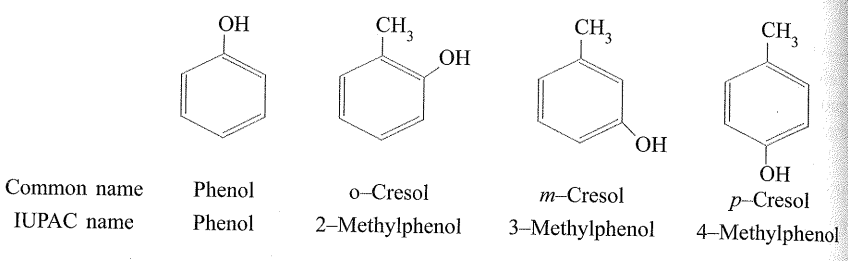
→ The simplest hydroxyl derivative of benzene is phenol. It is its common name and also an accepted IUPAC name. As structure of phenol involves a benzene ring, in its substituted compounds the term ortho (1,2- disubstituted), meta (1,3- disubstituted) and para (1,4- disubstituted) are often used in the common names.
Example:
Image
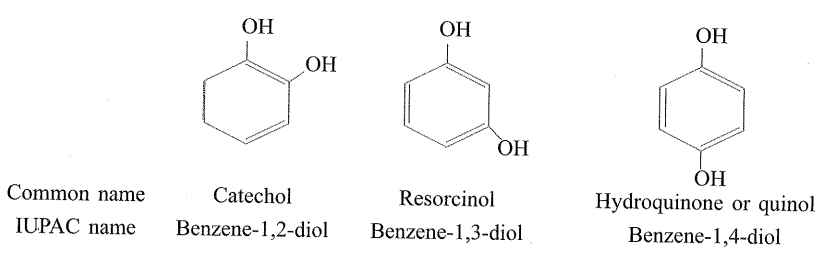
→ Dihydroxy derivatives of benzene are known as 1, 2, 1, 3- and 1, 4-benzenediol.
Image

Need a full question paper?

Generate a complete, print-ready paper with questions like this in minutes — across 16+ boards, with answer keys.
Start Generating Free

Similar questions

  1. Urea forms an ideal solution in water. Determine the vapour pressure of anaqueous solution containing 10% by mass of urea at 40°C. (Vapour pressure of water at 40°C = 55.3 mm of Hg)
  2. Why is freezing point depression of 0.1 M sodium chloride solution nearly twice that of 0.1 M glucose solution?
At 300K, 36g of glucose, C6H12O6 present per litre in its solution has an osmotic pressure of 4.98 bar. If the osmotic pressure of another glucose solution is 1.52 bar at the same temperature, calculate the concentration of the other solution.
Amino acids may be acidic, alkaline or neutral. How does this happen? What are essential and non-essential amino acids? Name one of each type.
Write down the IUPAC name for the following complex and indicate the oxidation state, electronic configuration and coordination number. Also give stereochemistry and magnetic moment of the complex:
K4[Mn(CN)6]
A 4% solution(w/ w) of sucrose (M = 342g mol-1) in water has a freezing point of 271.15K. Calculate the freezing point of 5% glucose (M = 180g mol-1) in water.
(Given: Freezing point of pure water = 273.15 K)
What happens when bromine reacts with $\text{CH}_3-\text{C}\equiv\text{CH}?$ How would you justify this reaction?
Explain electrolysis of concentration aqueous solution of NaCl
Name the reagents which are used in the following conversions:
i. A primary alcohol to an aldehyde
ii. Butan-2-one to butan-2-ol
iii. Phenol to 2, 4, 6-tribromophenol
Account for the following:
  1. Electrophilic substitution in case of aromatic amines takes place more readily than benzene.
  2. CH3CONH2 is a weaker base than CH3CH2NH2.
  3. Nitro compounds have higher boiling points than hydrocarbons having almost same molecular mass.
In a pseudo first order hydrolysis of ester in water, the following results were obtained:
t/s 0 30 60 90
[Ester]/mol L-1 0.55 0.31 0.17 0.085
  1. Calculate the average rate of reaction between the time interval 30 to 60 seconds.
  2. Calculate the pseudo first order rate constant for the hydrolysis of ester.