Question
Explain the parallel connection of capacitors.

Answer

Image

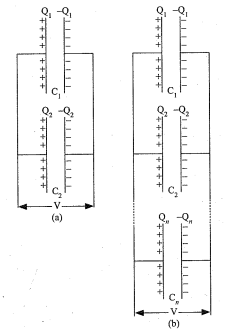
As shown in the fig. (a) two capacitors $C _1$ and $C _2$ are connected in parallel.
For such connection, the p.d. across each capacitor is same, suppose its value is V .
The charge on the plate of capacitor ' 1 ' is $\left(+Q_1\right)$ and the charge on the plate of capacitor ' 2 ' is $\left(+Q_2\right)$
$Q=C V$ for first capacitor $Q_1=C_1 V$ and for second capacitor $Q _2= C _2 V$
Hence, the total charge (/ charge of the equivalent capacitor)
$\begin{aligned}
Q & =Q_1+Q_2 \\
\therefore Q & =C_1 V+C_2 V \\
\therefore Q & =V\left(C_1+C_2\right) \\
\therefore \frac{Q}{V} & =C_1+C_2
\end{aligned}$
Suppose, the equivalent capacitance for the given parallel connection is C .
$\therefore C =\frac{ Q }{ V } \ldots$
$\therefore C = C _1+ C _2$ (From (1) and (2)
As shown in fig. (b), $C_1, C_2, C_3 \ldots . . C_n$ total n capacitors are connected in parallel. P.d. for each is V and the charge on each capacitor is $Q _1, Q _2, Q _3 \ldots . . Q _n$
Hence, the total charge,
$\begin{array}{l}
Q=Q_1+Q_2+Q_3+\ldots .+Q_n \\
\therefore Q = C _1 V+ C _2 V+ C _3 V+\ldots .+ C _n V \\
\therefore \frac{ Q }{ V }= C _1+ C _2+ C _3+\ldots . .+ C _n \\
\end{array}$
Suppose, the equivalent capacitance for the given parallel connection is C .
Where $\therefore C =\frac{ Q }{ V }$
So, from eq (3) and (4),
$C = C _1+ C _2+ C _3+\ldots . .+ C _n$
Suppose, the capacitance of each capacitor is same and it is ' $C ^{\prime}$
$\therefore$ Equivalent capacitance,
$\begin{aligned}
C _{e q} & = C + C + C +\ldots . .+ C \text { (n times) } \\
\therefore \quad\left( C _{e q}\right. & =n C )
\end{aligned}$

Need a full question paper?

Generate a complete, print-ready paper with questions like this in minutes — across 16+ boards, with answer keys.
Start Generating Free

Similar questions

A 3.0 cm wire carrying a current of 10 A is placed inside a solenoid perpendicular to its axis. The magnetic field inside the solenoid is given to be 0.27 T. What is the magnetic force on the wire?
Assume that the mass of a nucleus is approximately given by M = Amp where A is the mass number. Estimate the density of matter in kg/m3 inside a nucleus. What is the specific gravity of nuclear matter?
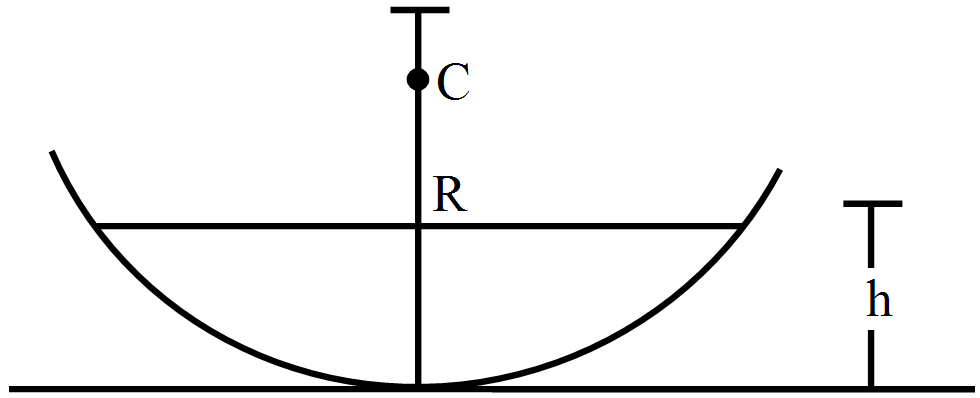
A concave mirror of radius R is kept on a horizontal. Water $\big($refractive index $=\mu\big)$ is poured into it upto a height h. Where should an object be placed so that its image is formed on itself?

What is Motional electromotive force (emf) ? Obtain motional emf $(\varepsilon)$= B I ${v}$ using proper example.
Two harmonic waves of monochromatic light

$\text{y}_{1} = \text{a} \cos\omega\text{t}\text{ and } \text{y}_{2} = \text{a} \cos(\omega\text{t} + \Phi)$

are superimposed on each other. Show that maximum intensity in interference pattern is four times the intensity due to each slit. Hence write the conditions for constructive and destructive interference in terms of the phase angle$\Phi$.
A light ray falling at an angle of 45° with the surface of a clean slab of ice of thickness 1m is refracted into it at an angle of 30°. Calculate the time taken by the light rays, to cross the slab. Speed of light in vacuum = 3 × 10⁸m/s
  1. What is linearly polarized light? Describe briefly using a diagram how sunlight is polarised.
  2. Unpolarised light is incident on a polaroid. How would the intensity of transmitted light change when the polaroid is rotated?
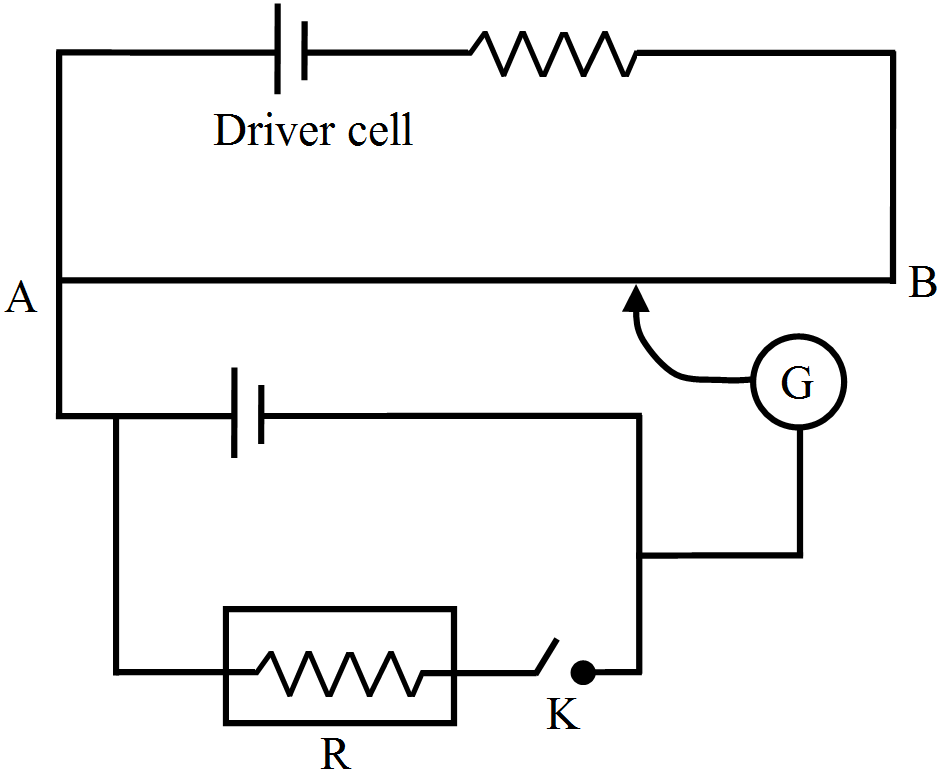
The following circuit shows the use of potentiometer to measure the internal resistance of a cell:

  1. When the key is open, how does the balance point change, if the current from the driver cell decreases?
  2. When the key K is closed, how does the balance point change if R is increased keeping current from the driver cell constant?
How much energy is released in the following reaction?
$\text{ }^7\text{Li + p}\rightarrow\alpha+\alpha.$
Atomic mass of 7Li = 7.0160u and that of 4He = 4.0026u.
A wire of length 1m and radius 0.1mm has a resistance of $100\Omega.$ Find the resistivity of the material.