Question
Explain the phenomenon of nuclear fission.

Answer

$\rightarrow $ When a heavy nucleus is bombarded with a neutron, then first neutron is absorbed. This nucleus is in a highly excited state. As a result, it splits into two lighter nuclei of approximately equal mass to become stable.
$\rightarrow $ Neutron is chargeless so it does not have to face coulomb forces. So neutron is a best projectile.
$\rightarrow $ When a neutron is bombarded on the nucleus of uranium its nucleus breaks into two almost equal parts. Its nuclear reaction is as below :
${ }_{92}^{235} U +{ }_0^1 n \rightarrow{ }_{92}^{236} U \rightarrow{ }_{56}^{144} B a+{ }_{36}^{89} K r+3\left({ }_0^1 n\right)+ Q$
${ }_{92}^{235} U +{ }_0^1 n \rightarrow{ }_{92}^{236} U \rightarrow{ }_{51}^{133} S b+{ }_{41}^{99} N b+4\left({ }_0^1 n\right)+ Q$
${ }_{92}^{235} U +{ }_0^1 n \rightarrow{ }_{92}^{236} U \rightarrow{ }_{54}^{140} Xe +{ }_{38}^{94} S r+2\left({ }_0^1 n\right)+ Q$
$\rightarrow $ The fission fragments are radioactive and by successive emmision of $\beta$-particles results in the stable nuclei.
$\rightarrow $ During the fission process of uranium the energy released per fission is almost $200 \ MeV$ .
$\rightarrow $ Suppose a nucleus with mass number $A =240$ breaks into two fragments each of $A =120$.
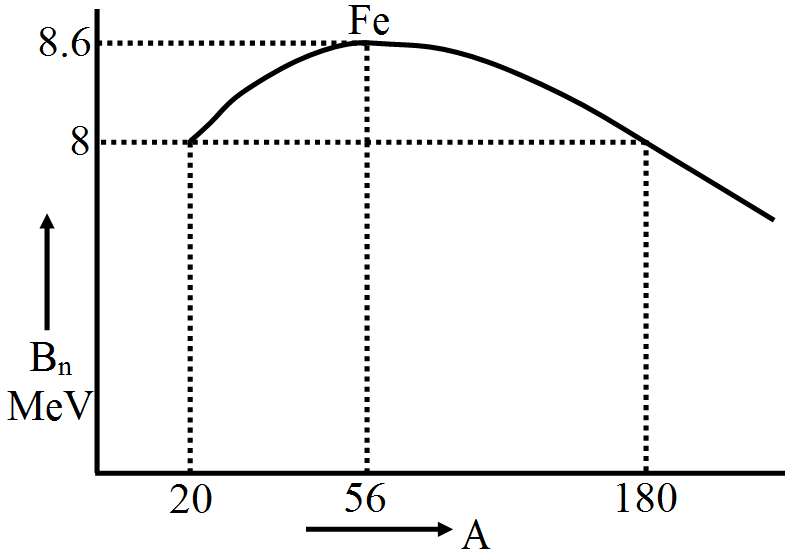
$\rightarrow $ Binding energy per nucleon for a nucleus with $A =240$ is $7.6 \ MeV$ and for a nucleus with $A =120$ is $8.5 \ MeV .$
$\rightarrow $ Gain in binding energy per nucleon
$=8.5-7.6$
$=0.9 MeV$
$\rightarrow $ Total gain in binding energy
$=0.9 \times 240$
$=216 MeV .$
$\rightarrow $ The disintegration energy in fission events first appears as the kinetic energy of the fragments and neutrons. Eventually it is transferred to the surrounding matter appearing as heat.
$\rightarrow $ In a nuclear reactor this process takes place in a controlled manner whereas in an atomic bomb this process takes place in an uncontrolled manner.

Need a full question paper?

Generate a complete, print-ready paper with questions like this in minutes — across 16+ boards, with answer keys.
Start Generating Free

Similar questions

Which wavelengths will be emitted by a sample of atomic hydrogen gas (in ground state) if electrons of energy 12.2eV collide with the atoms of the gas?
  1. Mention two properties of soft iron due to which it is preferred for making an electromagnet.
  2. State Gauss's law in magnetism. How is it different from Gauss's law in electrostatics and why?
Compute the typical de Broglie wavelength of an electron in a metal at 27ºC and compare it with the mean separation between two electrons in a metal which is given to be about $2 \times 10^{–10} m.$
Using $\text{B}=\mu_0\text{H},$ find the ratio $\frac{\text{E}_0}{\text{H}_0}$ for a plane electromagnetic wave propagating through vacuum. Show that it has the dimensions of electric resistance. This ratio is a universal constant called the impedance of free space.
A hot gas emits radiation of wavelengths 46.0nm, 82.8nm and 103.5nm only. Assume that the atoms have only two excited states and the difference between consecutive energy levels decreases as energy is increased. Taking the energy of the highest energy state to be zero, find the energies of the ground state and the first excited state.
A 12.9 eV beam of electrons is used to bombard gaseous hydrogen at room temperature. Upto which energy level the hydrogen atoms would be excited? Calculate the wavelength of the first member of Paschen series and first member of Balmer series.
A thin conducting spherical shell of radius R has charge Q spread uniformly over its surface. Using Gauss’s law, derive an expression for an electric field at a point outside the shell.Draw a graph of electric field E(r) with distance r from the centre of the shell for $0\underline{<}\text{r}\underline{<}\infty.$
A cylindrical object of outer diameter 10cm, height 20cm and density $8000kg/m^3$ is supported by a vertical spring and is half dipped in water as shown in.
  1. Find the elongation of the spring in equilibrium condition.
  2. If the object is slightly depressed and released, find the time period of resulting oscillations of the object. The spring constant = 500N/m.
Consider earth satellites in circular orbits. A geostationary satellite must be at a height of about 36000km from the earth's surface. Will any satellite moving at this height be a geostationary satellite? Will any satellite moving at this height have a time period of 24 hours?
Draw the graph showing the variation of binding energy per nucleon with mass numbers. Give the reason for the decrease of binding energy per nucleon for nuclei with higher mass number.