Question
Explain the phenomenon of nuclear fission.

Answer

When a heavy nucleus is bombarded with a neutron, then first neutron is absorbed. This nucleus is in a highly excited state. As a result, it splits into two lighter nuclei of approximately equal mass to become stable.
Neutron is chargeless so it does not have to face coulomb forces. So neutron is a best projectile.
When a neutron is bombarded on the nucleus of uranium its nucleus breaks into two almost equal parts. Its nuclear reaction is as below :
$\begin{array}{l}
{ }_{92}^{235} U +{ }_0^1 n \rightarrow{ }_{92}^{236} U \rightarrow{ }_{56}^{144} B a+{ }_{36}^{89} K r+3\left({ }_0^1 n\right)+ Q \\
{ }_{92}^{235} U +{ }_0^1 n \rightarrow{ }_{92}^{236} U \rightarrow{ }_{51}^{133} S b+{ }_{41}^{99} N b+4\left({ }_0^1 n\right)+ Q \\
{ }_{92}^{235} U +{ }_0^1 n \rightarrow{ }_{92}^{236} U \rightarrow{ }_{54}^{140} Xe +{ }_{38}^{94} S r+2\left({ }_0^1 n\right)+ Q
\end{array}$
The fission fragments are radioactive and by successive emmision of $\beta$-particles results in the stable nuclei.
During the fission process of uranium the energy released per fission is almost 200 MeV .
Suppose a nucleus with mass number $A =240$ breaks into two fragments each of $A =120$.
Binding energy per nucleon for a nucleus with $A =240$ is 7.6 MeV and for a nucleus with $A =120$ is 8.5 MeV .
Gain in binding energy per nucleon
$\begin{array}{l}
=8.5-7.6 \\
=0.9 MeV
\end{array}$
Total gain in binding energy
$\begin{array}{l}
=0.9 \times 240 \\
=216 MeV .
\end{array}$
The disintegration energy in fission events first appears as the kinetic energy of the fragments and neutrons. Eventually it is transferred to the surrounding matter appearing as heat.
In a nuclear reactor this process takes place in a controlled manner whereas in an atomic bomb this process takes place in an uncontrolled manner.

Need a full question paper?

Generate a complete, print-ready paper with questions like this in minutes — across 16+ boards, with answer keys.
Start Generating Free

Similar questions

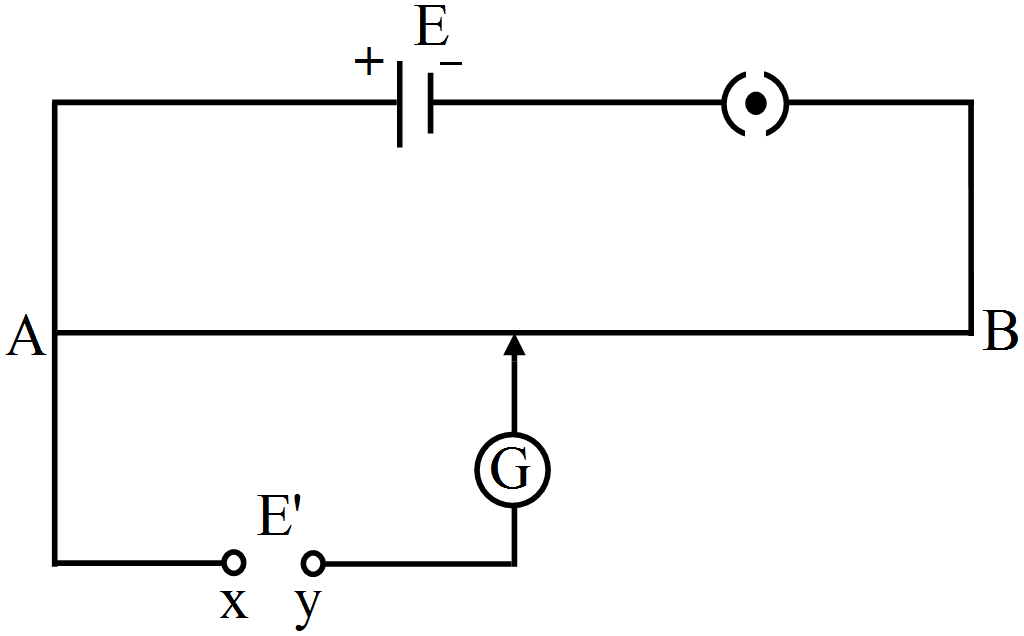
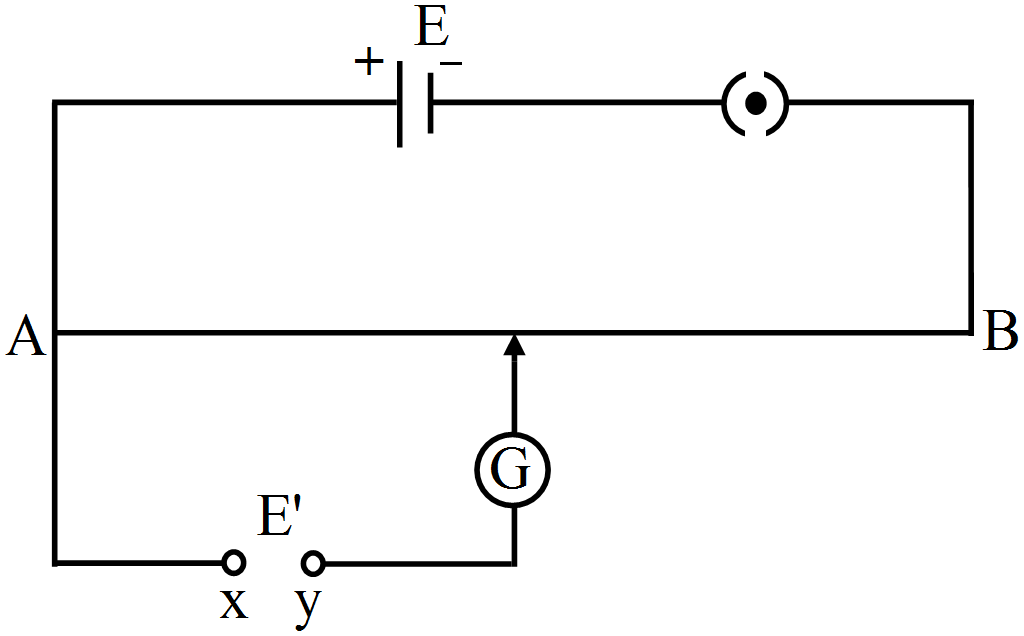
For the potentiometer circuit shown in the given figure, points X and Y represent the two terminals of an unknown emf E'. A student observed that when the jockey is moved from the end A to the end B of the potentiometer wire, the deflection in the galvanometer remains in the same direction.

What may be the two possible faults in the circuit that could result in this observation?

If the galvanometer deflection at the end B is (i) more, (ii) less than at the end A, which of the two faults, listed above, would be there in the circuit? Give reason in support of your answer in each case.

A parallel plate capacitor, each with plate area A and separation d, is charged to a potential difference V. The battery used to charge it is then disconnected. A dielectric slab of thickness d and dielectric constant K is now placed between the plates. What change, if any, will take place in.

  1.  Charge on the plates.
  2. Electric field intensity between the plates.
  3. Capacitance of the capacitor.
A person standing on a platform finds that a train moving with velocity 0.6c takes one second to pass by him. Find:
  1. The length of the train as seen by the person and.
  2. The rest length of the train.
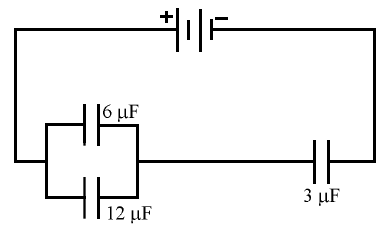
  1. In the following arrangement of capacitors, the energy stored in the 6 μF capacitor is E. Find the value of the following:
  2. Energy stored in 12 μF capacitor.
  3. Energy stored in 3 μF capacitor.
  4. Total energy drawn from the battery.

If mercury and glass had equal coefficient of volume expansion, could we make a mercury thermometer in a glass tube?
If the operating potential in an X-ray tube is increased by 1%, by what percentage does the cutoff wavelength decrease?
Three circuits, each consisting of a switch ‘S’ and two capacitors, are initially charged, as shown in the figure. After the switch has been closed, in which circuit will the charge on the left-hand capacitor (i) increase, (ii) decrease and (iii) remain same? Give reasons.

(a) Which of the following can be a source for origin of electromagnetic waves? Give reason.
(i) A charge moving with constant speed
(ii) Charge undergoing circular motion
(iii) Fixed charge.
(b) Name that part of electromagnetic spectrum with which waves of frequency
(i) $10^{20} Hz$,
(ii) $10^9 Hz$ associated.
A ceiling fan has a diameter (of the circle through the outer edges of the three blades) of 120cm and rpm 1500 at full speed. Consider a particle of mass 1g sticking at the outer end of a blade. How much force does it experience when the fan runs at full speed? Who exerts this force on the particle? How much force does the particle exert on the blade along its surface?
Draw the circuit diagram of a common emitter amplifier using n-p-n transistor. What is the phase differnece between the input signal and output voltage? State two reasons why a common emitter amplifier is preferred to a common base amplifier.