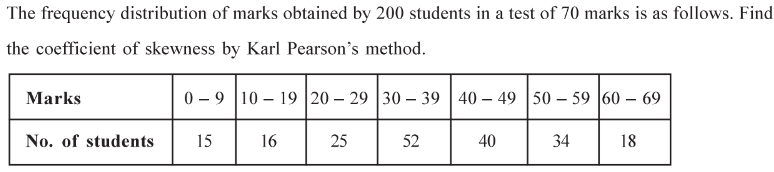
Question
Explain the positional averages briefly.

Answer

If the observations of the data are not distributed around the average, then mean is not good representative measure of observations of the data.
In this circumstances to know the characteristic of the data at various places, considering the observations related to particular place of the data, the measure of average is obtained.
Such measure of average is known as the positional average.
Median is such a positional average. Besides this Quartiles, Deciles and Percentiles are also the measures of the positional average.
Median: The value of observation dividing the observations of the data arranged in ascending or descending order of magnitudes into two equal parts is called median of the data. It is denoted by $M$.
It represent the average value of $50 \%$ of observations.
Quartiles: The values of observations dividing the sequence of observations of a given data arranged in the increasing or decreasing order of their magnitudes, into four equal parts are called Quartiles.
There are three Quartiles and they are symbolically denoted as $Q_{1}, Q_{2}$ and $Q_{3}$.
Deciles : The values of observations dividing the observations of a given data arranged In Increasing or decreasing order of their magnitudes in ten equal parts are called Deciles.
There are $9$ declles. They are denoted by the symbol $D_{1}, D_{2}, D_{3} D_{9} .$ Percentiles:
The values of observations dividing the observations of a given data arranged in increasing or decreasing order of their magnitudes in hundred equal parts are called Percentiles.
There are $99$ Percentiles.
They are denoted by symbol $P_{1}, P_{2}, P_{3}, \ldots P_{99}$.

Need a full question paper?

Generate a complete, print-ready paper with questions like this in minutes — across 16+ boards, with answer keys.

Start Generating Free

Similar questions

The commission paid on insurance policy amounts to agents in a branch of an insurance company during a month has the following frequency distribution.
Find the coefficient of skewness by Bowley's method.
Commission paid(thousand Rs.) $10-12$ $12-14$ $14-16$ $16-18$ $18-20$ $20-22$ $22-24$ $24-26$ $26-28$ $28-30$
No. of companies $4$ $10$ $16$ $29$ $52$ $80$ $32$ $23$ $17$ $1$
A factory manufactures certain items in two shifts. The information regarding the time taken by workers to manufacture the items is given below. Using the following information, find the combined standard deviation :
Out of $300$ persons residing in a region, a sample of $30$ persons is selected at random and the heights (in $cm$.) of these selected persons are as under :
$\text{163 148 151 162 145 152 149 158 153 149 150 152 145 141 162 168 148 158 149 141 146 155 159 150 161 153 162 160 154 165}$
$(i)$ Distribute these data into $6$ classes and also find the mid value of each class.
$(ii)$ Obtain ‘less than’ type cumulative frequency distribution.
$(iii)$ What is the percentage of persons having height less than $155 \ cm.$?
$(iv)$ Obtain ‘more than’ type cumulative frequency distribution.
$(v)$ How many persons have the height between $147$ to $157 \ cm.$?
Find the percentage of observations lying within the limits $x ± s$ using the following distribution of credit days taken by the merchants:
Credit days $12$ $13$ $14$ $15$ $16$ $17$ $18$ $19$
No. of merchants $5$ $10$ $25$ $65$ $45$ $35$ $8$ $7$
The following information is about the annual advertisement cost (in lakh $?$) of $30$ companies. Find skewness and coefficient of skewness using it.

Image
For two groups $T_{1}$ and $T_{2}$, taking $A =25$ the following information are obtained:
Group $T_{1}: n_{1}=10 ; \sum d=30 ; \sum d^{2}=12340$
Group $T_{2}: n_{2}=20 ; \sum d=-20 ; \sum d^{2}=24520$
A sample of $25$ lenses is selected from a day’s production of a company manufacturing eye lenses. The thicknesses (in millimeter) of these selected lenses are as under. Distribute these data into five classes of equal length.
$1.518, 1.509, 1.527, 1.505, 1.520,$
$1.511, 1.518, 1.522, 1.528, 1.528,$
$1.520, 1.520, 1.514, 1.508, 1.525,$
$1.506, 1.519, 1.523, 1.521, 1.517,$
$1.514, 1.515, 1.516, 1.521, 1.507$
If the company decides that the lenses having thicknesses less than $1.510$ and more than $1.525$ are considered as defective then what per cent of lenses in the sample are defective ?
The data about rainfall (in $cm$) at a place in a month during monsoon are obtained as follows. Find the skewness and coefficient of skewness using Bowley’s method.
The wheat crop grown per acre by farmers in different parts of a state is given below.
Wheat crop acre (quintals) $20 – 25$ $25- 30$ $30- 40$ $40 – 50$ $50 – 60$
No. of farmers $12$ $23$ $45$ $29$ $7$