Maharashtra BoardEnglish MediumSTD 12 SciencePhysicsQuestion Bank [ 2022 ]2 Marks
Question
Explain the principle of a capacitor.
✓
Answer
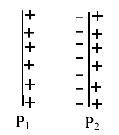
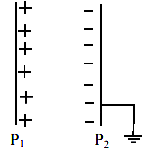
i. Consider a metal plate $P _1$ having area $A$ with some positive charge $+Q$ be given to the plate. Let its potential be $V$. Its capacity is given by, $C _1=\frac{ Q }{ V }$ ii. Now consider another insulated metal plate $P_2$ held near plate $P_1$. By induction, a negative charge is produced on the nearer face and an equal positive charge develops on the farther face of $P_2$ as shown in figure (a) below. (a) iii. The induced negative charge lowers the potential of plate $P_1$, while the induced positive charge raises its potential. iv. As the induced negative charge is closer to $P_1$ it is more effective, and thus there is a net reduction in the potential of plate $P_1$. If the outer surface of $P_2$ is connected to the earth, the induced positive charges on $P_2$ being free, flows to earth. The induced negative charge on $P_2$ stays on it, as it is bound to the positive charge of $P_1$. This greatly reduces the potential of $P_2$ as shown in figure (b) below. (b) v. If $V_1$ is the potential on plate $P_2$ due to charge $(-Q)$ then the net potential of the system will now be $+ V - V _1$. Hence the capacity $C_2=\frac{Q}{V-V_1}$ $ \therefore C _2> C _1 $ vi. Thus, the capacity of metal plate $P_1$ is increased by placing an identical earth-connected metal plate $P_2$ near it.
Need a full question paper?
Generate a complete, print-ready paper with questions like this in minutes — across 16+ boards, with answer keys.