Question
Explain the principle of insertional inactivation by giving a suitable example.

Answer

In this method a recombinant DNA is inserted in the gene which inactivates the functioning of gene. Insertional inactivation is a efficient method to identify transformants.
Example:
Blue-white selection method: In this method, cloned DNA is inserted into the lac Z gene present on the vector. After insertion the lac Z gene is inactivated. The lac Z gene forms β−galactosidase enzyme which can break X-gal (a synthetic colourless substrate) into a blue coloured product. Thus, transformants will contain interrupted lac Z gene which will not produce β−galactosidase, appear in white colonies in the presence of X-gal.

Need a full question paper?

Generate a complete, print-ready paper with questions like this in minutes — across 16+ boards, with answer keys.
Start Generating Free

Similar questions

The harmful allele of sickle cell anemia has not been eliminated from human population. Such afflicted people derive some other benefit. Discuss.
You are given a red flower–bearing pea plant and a red flower–bearing snapdragon plant. How would you find the genotypes of these two plants with respect to the colour of the flower? Explain with the help of crosses. Comment upon the pattern of inheritance seen in these two plants.
Answer the following questions:
Explain the hormonal regulation of the process of spermatogenesis in humans.
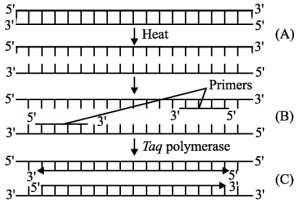
The melding of a technique for repeated rounds of DNA synthesis with the discovery of a thermostable DNA polymerase has given scientists the very powerful technique known as polymerase chain reaction (PCR). PCR is based on three simple steps required for any DNA synthesis reaction: (1) denaturation of the template into single strands; (2) annealing of primers to each original strand for new strand synthesis; and (3) extension of the new DNA strands from the primers.
In the given figure, one cycle of polymerase chain reaction (PCR) is shown:
Image
i. Name the steps A, B and C.
ii. Give the purpose of each of these steps.
iii. State the contribution of Thermus aquaticus in this process.
(i) Explain the significance of each of the following features present in plants given below:, (a) In rose-bay plant the stamens ripen before the stigma., (b) In certain species of primrose, the flowers have short stamen and long style., (c) The bisexual flower of mustard exhibits rejection of self-pollen grain., (ii) Explain how autogamy is prevented in castor and papaya plant respectively.
Answer the following questions:
State and explain the law of dominance as proposed by Mendel.
Represent diagrammatically the steps in amplification of a DNA segment. Who designed the process?
Discuss the role of microbes as biofertilisers in detail.
Discuss the causes and effects of global warming. What measures need to be taken to control global warming?
  1. Following are the responses of different animals to various abiotic factors. Describe each one with the help of an example.
  1. Regulate.
  2. Conform.
  3. Migrate.
  4. Suspend.
  1. If 8 individuals in a population of 80 butterflies die in a week, calculate the death rate of population of butterflies during that period.