Question
Explain the procedure of balancing the personal accounts.

Answer

From the balancing of these accounts we can ascertain as to how much amount is owing from each individual customer and how much amount is owed to each individual creditor. If a personal account shows a debit balance, it indicates the amount owing from him. On the contrary, if a personal account shows a credit balance, it indicates the amount owing to him.In case the total of the debit side is in excess of the credit side, the difference between the two is inserted on the credit side of the account in order to make their totals equal. The words ‘By Balance c/d’, i.e., balance carried down are written against the amount of the difference. In the next accounting period, the balance is brought down on the debit side by writing the words ‘To Balance b/d'.
On the contrary, if the total of the credit side is in excess of the debit side, the difference between the two is inserted on the debit side of the account in order to make their totals equal. The words ‘To Balance c/d' are written against the amount of the difference. In the next accounting period, the balance is brought down on the credit side by writing the words 'By Balance b/d’.

Need a full question paper?

Generate a complete, print-ready paper with questions like this in minutes — across 16+ boards, with answer keys.
Start Generating Free

Similar questions

On 21st Sept. 2017, Radhika sold goods for ₹ 2,00,000 to Parvati and drew upon later a bill for the same amount payable after 3 months. The bill was accepted by Parvati, Radhika discounted the bill from bank at a discount of 15% p.a. on 21st Oct., 2017. On maturity, the bill was dishonoured. Parvati agreed to pay ₹ 1,20,000 in cash including ₹ 3,000 interest and accepted a new bill for 3 months. The new bill was endorsed to Gayatri in full settlement of his account ₹ 85,000. It was duly met on maturity. Pass entries in the books of Radhika.
Prepare a Bank Reconciliation Statement on 31 December, 2014 from the following particulars:
  1. A's overdraft as per Pass Book ₹ 20,000 as at 31st Dec.
  2. On 30th December, cheques had been issued for ₹ 80,000, of which cheques worth ₹ 15,000 only had been encashed up to 31st December.
  3. Cheques amounting to ₹ 6,500 had been paid into the bank for collection but of these only ₹ 2,500 had been credited in the Pass Book.
  4. The bank has charged ₹ 700 as interest on overdraft and the intimation of which has been received on 2nd January 2015.
  5. The Bank Pass Book shows credit for ₹ 2,000 representing ₹ 1,400 paid by debtor of A direct into the bank and ₹ 600 collected direct by bank in respect of interest on A,s investment. A had no knowledge of these items.
  6. A cheque for ₹ 3,600 has been debited in bank column of Cash Book by A, but it was not sent to bank at all.
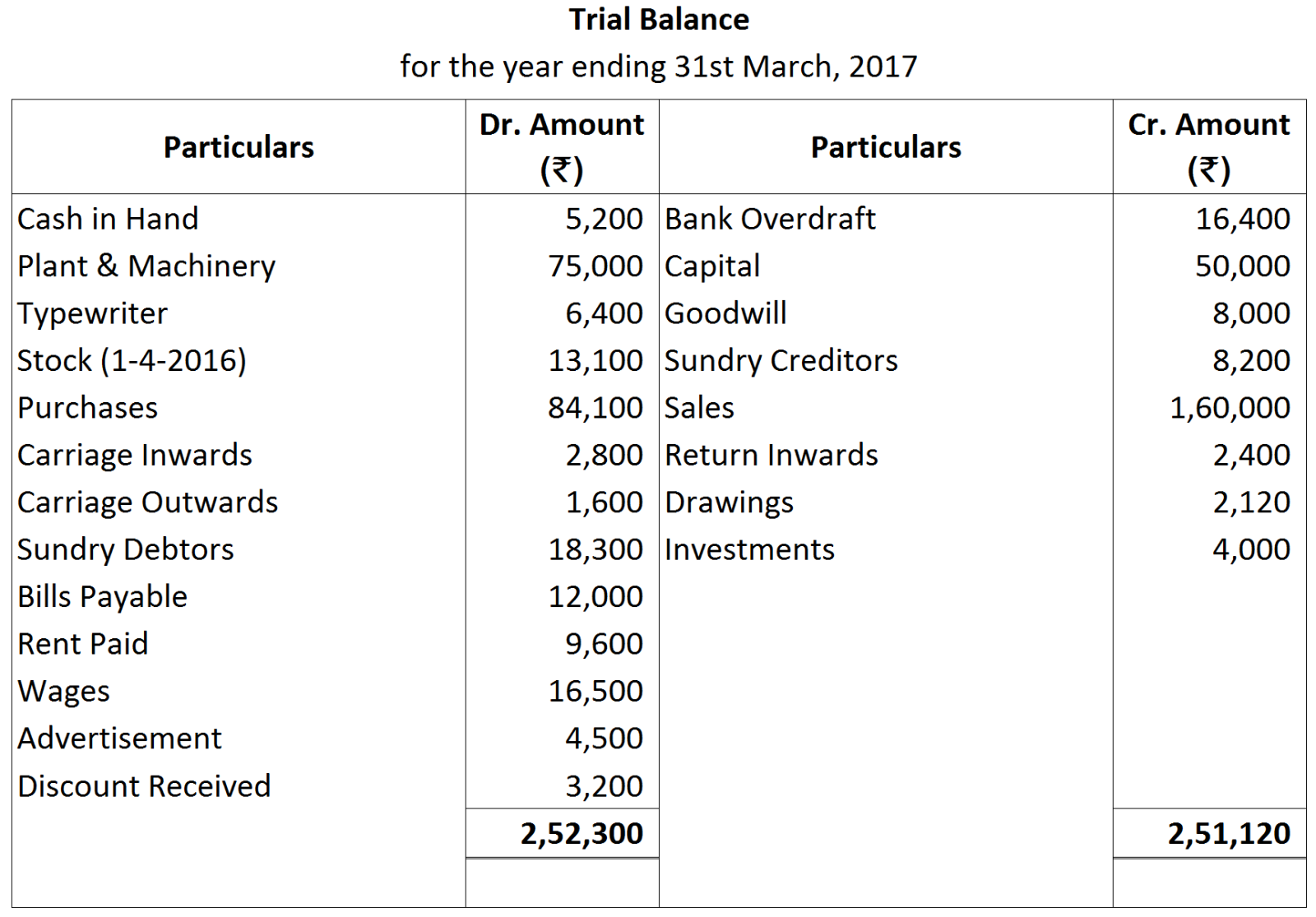
The following is the Trial Balance prepared by an inexperienced accountant. Redraft it in a correct form and give necessary notes :-
Ganga Ltd. purchased a machinery on January 01,2014 for ₹ $5,50,000$ and spent ₹ 50,000 on its installation. On September 01, 2014 it purchased another machine for ₹ $3,70,000$. On May 01,2015 it purchased another machine for $₹ 8,40,000$ (including installation expenses). Depreciation was provided on machinery @10\% p.a. on original cost method annually on December 31. Prepare:
i. Machinery account and depreciation account for the years 2014, 2015, 2016 and 2017.
ii. If depreciation is accumulated in provision for Depreciation account then prepare machine account and provision for depreciation account for the years 2014, 2015,2016 and 2017.
Journalise the following transactions:
  1. Purchased a Motor Car for 3,00,000 and paid 25,000 for its repair and renewal. Entire payment is made by cheque.
  2. Received Rent 5,000.
  3. Goods worth 20,000 were distributed as free samples.
  4. Charge depreciation on Motor Car 32,500.
  5. Rent due to Landlord 10,000 and Salary due to Clerks 80,000.
  6. Charge interest on Capital 20,000.
  7. 5,000 due from Sanjay Gupta are bad-debts.
  8. Goods worth 50,000 were destroyed by fire.
  9. ash 5,000 and goods worth 20,000 were stolen by an employee.
X Ltd. purchased a plant on 1st July, 2010 costing ₹ 5,00,000. It purchased another plant on 1st September, 2010 costing ₹ 3,00,000. On 31st December, 2012, the plant purchased on 1st July, 2010 got out of order and was sold for ₹ 2,15,000. Another plant was purchased to replace the same for ₹ 6,00,000. Depreciation is to be provided at 20% p.a. according to Writen Down Value Method. The accounts are closed every year on 31st March.
Show the Plant Account and Provision for Depreciation Account.
Rectify the following errors:-
  1. ₹ 4,500 spent on the extension of Buildings were debited to Repairs A/c.
  2. Wages paid to the firm's own workmen ₹ 3,600 for the installation of a new machinery were posted to Wages Account.
  3. Contractor's bill for the construction of a godown at a cost of ₹ 10,000 has been charged to 'Repairs' A/c.
  4. ₹ 1,500 paid as Wages to a worker 'Bahadur Singh', has been debited to his personal account.
  5. Old furniture sold for ₹ 500 has been credited to Sales Account.
  6. A cheque of ₹ 620 received from Ram, has been wrongly credited to Shyam.
Rectify the following errors assuming that a suspense account was opened. Ascertain the difference in trial balance.
  1. Credit sales to Mohan ₹ 7,000 were posted to Karan as ₹ 5,000.
  2. Credit purchases from Rohan ₹ 9,000 were posted to the debit of Gobind as ₹ 10,000.
  3. Goods returned to Rakesh ₹ 4,000 were posted to the credit of Naresh as ₹ 3,000.
  4. Goods returned from Mahesh ₹ 1,000 were posted to the debit of Manish as ₹ 2,000.
  5. Cash sales ₹ 2,000 were posted to commission account as ₹ 200.
What is meant by maturity of a bill of exchange?
Mr. Chaturvedi maintains two bank accounts. Prepare his columnar cash book from the following particulars:
2016
 
(₹)
May 1
Cash in hand
34,000
Balance with Hongkong Bank
75,200
Balance with Citi Bank
1,20,000
May 3
Cash drawn from Citi Bank for office use
25,000
May 8
Sold goods to Diwedi for ₹ 80,000 and received from him ₹ 20,000 in cash and a cheque for the balance. The cheque is deposited in Hongkong Bank on 9th and the bank credited the amount on 15th and debited ₹ 25 as its collection charges.
 
May 12
Purchased goods for ₹ 40,000 at 20% trade discount. 25% of the amount is paid in cash and issued a cheque on Citi Bank for the balance amount.
 
May 20
Paid Wages ₹ 36,000 and Salary ₹ 4,000.
 
May 22
A cheque for ₹ 50,000 is drawn on Citi Bank and it is deposited in Hongkong Bank.
 
May 23
Purchased land for ₹ 3,20,000 and a cheque is issued on Hongkong Bank.
 
May 24
A cheque for ₹ 10,000 which was received from Mohan and was deposited in Citi Bank on 25th April is dishonoured and the bank debited ₹ 100 as bank charges on this cheque. The amount of dishonoured cheque and bank charges is received from Mohan in cash on 25th.
 
May 26
Deposited cash ₹ 30,000 in Hongkong Bank.
 
May 28
Sold old typewriter for ₹ 2,000 and old newspapers for ₹200 in cash.
 
May 30
Interest charged by Hongkong Bank ₹ 400.
 
May 31
Bank charges by Citi Bank ₹ 180 and Hongkong Bank ₹ 340.